Waterborne Pathogens in Untreated Water: A Realistic Look
PortaWell Admin
Author
In short: Waterborne pathogens in untreated water do not usually make people sick, but some exposures do. Risk depends on the organism, the dose, and who is drinking. Giardia and Cryptosporidium are among the toughest common causes of waterborne illness. What's upstream tells you how much treatment you need. The usual order is to filter first, then disinfect, especially when people may have contaminated the source.
Most exposures to waterborne pathogens do not make people sick. Some do. Understanding why helps you judge the risk instead of fearing it.
Ask ten people about drinking straight from a mountain stream and you will get ten answers. Some will tell you never, under any circumstances. Others have done it for decades without a problem. Both are partly right, because the risk is not a simple yes or no.
Whether water makes you sick comes down to three things:
- Which organism is in it. Some die off in days and respond quickly to chlorine. Others survive for months and shrug chlorine off.
- How many you swallow. For some organisms a handful is enough. For others it takes thousands.
- Who is drinking. A healthy adult may never notice an exposure that puts a toddler or an older parent in the hospital.
This article is background behind PortaWell's practical guides. You do not need it to use a PortaWell system or to follow the steps in filtering river, creek, and pond water and chlorine for emergency water treatment. It is for readers who want to understand why those steps work: why some water is riskier than other water, why the usual order is filter then disinfect, and why a jug of stored water does not go bad on its own.
The goal is a realistic picture, neither alarmist nor dismissive. Nature works against most of these organisms, and the right treatment handles the rest. Clear water is not automatically finished water, and a little knowledge goes a long way when your source is not a tap.
PortaWell builds a 12V cartridge filter in Hooper, Utah. This page is not a product test. The PortaWell MINI does not remove salt or dissolved solids, and PortaWell does not claim virus reduction. Untrusted water still needs a separate disinfection step after filtration, such as boiling or chlorination.
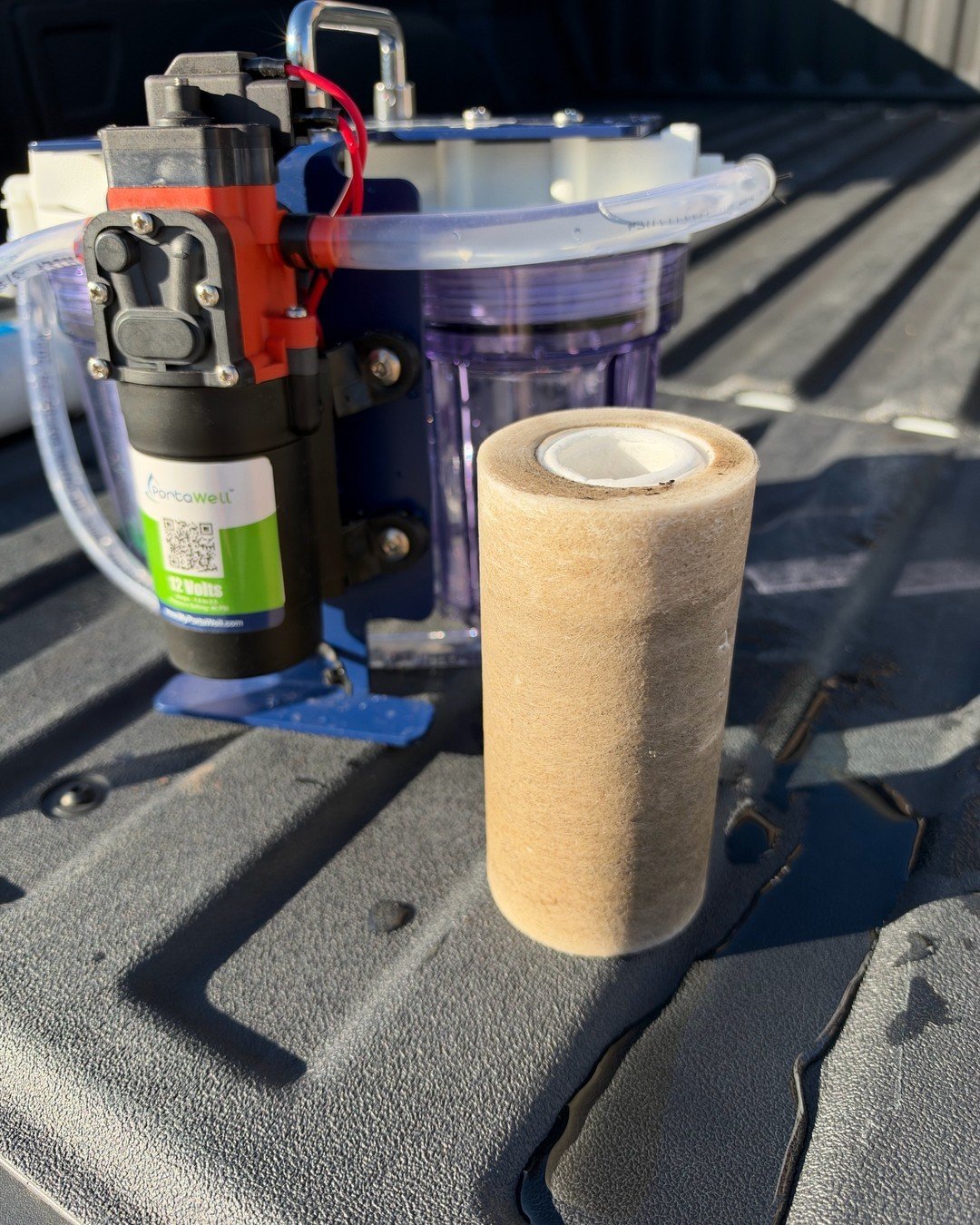
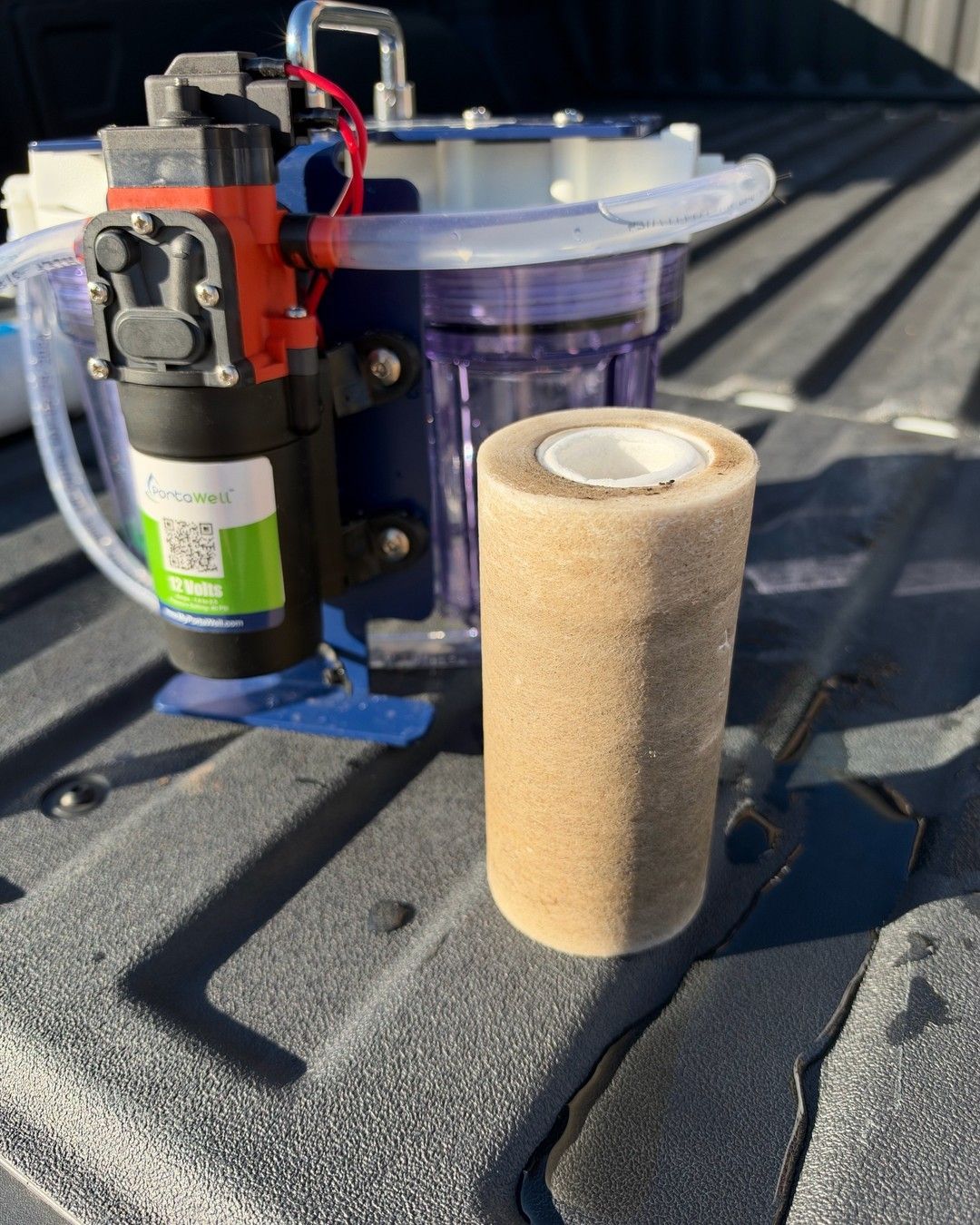
A PortaWell MINI after field use. Filtering first clears sediment so a later disinfection step, such as boiling or chlorine, can work more predictably.
What kinds of waterborne pathogens cause illness?
Protozoa, bacteria, and viruses cause nearly all waterborne illness in the U.S. Parasitic worms and bacterial spores round out the picture. Their differences in size, toughness, and resistance to chlorine explain why no single treatment method handles everything equally well.
A sense of scale. If a Giardia cyst were the size of a basketball, a typical bacterium would be about the size of a marble, and a virus would be a grain of sand. A parasitic worm egg would be about five feet across. That range, roughly 3,000 to 1 from largest to smallest, is why filtration and disinfection are usually used together rather than as substitutes.
- Examples — Protozoa: Giardia, Cryptosporidium — Bacteria: E. coli, Salmonella, Shigella, Campylobacter — Viruses: Norovirus, hepatitis A — Helminths (worm eggs): Roundworm (Ascaris), tapeworms — Bacterial spores: Clostridium, Bacillus
- Relative size — Protozoa: Largest of the three common types — Bacteria: Much smaller than protozoa — Viruses: Far smaller than bacteria; most cartridge filters are not a complete treatment — Helminths (worm eggs): Larger than protozoa — Bacterial spores: Similar in scale to bacteria
- Survival form — Protozoa: Tough cyst or oocyst shell — Bacteria: None; exposed cell — Viruses: Protein coat — Helminths (worm eggs): Thick-shelled egg — Bacterial spores: Dormant spore
- Survival in water — Protozoa: Weeks to months — Bacteria: Days to a few weeks — Viruses: Days to months — Helminths (worm eggs): Months to years — Bacterial spores: Years
- Chlorine — Protozoa: Moderate (Giardia) to extreme (Cryptosporidium) resistance — Bacteria: Usually responds quickly — Viruses: Low to moderate resistance — Helminths (worm eggs): High resistance — Bacterial spores: High resistance
- Main sources — Protozoa: Animals and people — Bacteria: Animals and people — Viruses: People — Helminths (worm eggs): Human and animal feces, soil — Bacterial spores: Soil, feces
- U.S. drinking-water risk — Protozoa: High — Bacteria: High — Viruses: Moderate; mainly from human waste — Helminths (worm eggs): Rare — Bacterial spores: Rare
- Practical treatment note — Protozoa: A tight, tested filter is the usual first step — Bacteria: Filter first, then disinfect — Viruses: Follow filtration with boiling, chlorine, or UV; do not treat a cartridge filter as a complete barrier — Helminths (worm eggs): Readily reduced by ordinary filtration — Bacterial spores: Reduced by tight filtration; uncommon in drinking water
Sizes in this article are described relatively, not as a PortaWell filter rating. This draft does not assign a particle-size rating to the PortaWell system.
Protozoa: small numbers, lasting trouble. Protozoa are single-celled parasites. Inside the gut they multiply rapidly, and they leave the body as cysts: dormant, armored forms built to survive outside a host. Cysts are the toughest of the three common types in the environment and the most resistant to chlorine, and it takes only a handful to cause illness. Their relative weakness is size, which is why a tight, tested filter is the usual first step against them.
Bacteria: fragile outside the body. The intestinal bacteria that cause waterborne illness have no protective shell. Outside the body they are exposed to sunlight, cold, and competition, and most die within days to weeks. Chlorine typically works in seconds to minutes. They are smaller than protozoa, so filtration alone is a weaker story; a disinfection step is the usual complement.
Viruses: tiny and human-specific. Viruses are bits of genetic material in a protein coat that can only reproduce inside a host's cells. They are far smaller than the organisms a typical cartridge filter is built to reduce. Chlorine, UV, and boiling are the usual finishers. The intestinal viruses that matter in drinking water, such as norovirus and hepatitis A, infect only people, so they come from human waste, not from wildlife. PortaWell does not claim virus reduction.
Helminths: big, tough, and rare here. Helminths are parasitic worms, and they spread through eggs passed in feces. The eggs are among the hardiest things in nature: roundworm eggs can survive for years in soil and resist chlorine. Worldwide, they infect over a billion people, mostly where sanitation is poor. In the U.S. they are rarely a drinking-water concern, and their large size makes them comparatively easy to filter. In grazing areas, the sheep liver fluke can contaminate water and water plants, but human cases in the U.S. are rare and usually come from eating raw watercress.¹
Bacterial spores: built to last. A few bacteria, including Clostridium and Bacillus, can shut down into dormant spores when conditions turn harsh. Spores survive heat, drying, and chlorine for years, and they resist boiling far longer than other organisms. The illnesses they cause, such as food poisoning, tetanus, and C. diff infection, mostly come from food, soil, wounds, and hospitals rather than drinking water. Because Clostridium spores outlast other fecal organisms, water labs sometimes test for them as a sign of past sewage contamination.
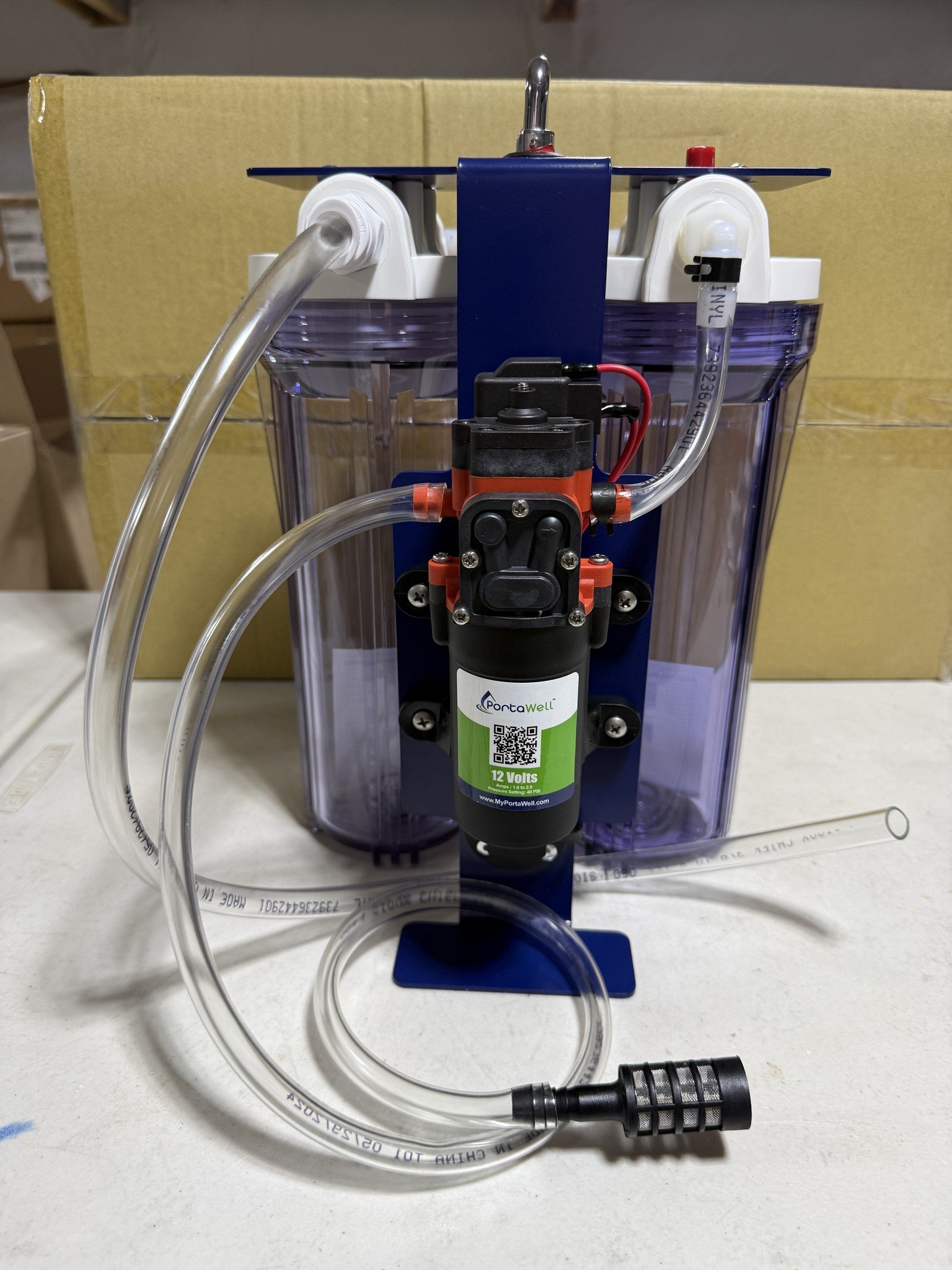
A PortaWell MINI with its intake hose and strainer. Draw water without stirring the bottom, and let cloudy water settle before it reaches the filter.
What happens to these organisms once they are in water?
Disease-causing organisms do not multiply in clean water. They survive for a while and then die off, but at very different rates.
They need a host. Most people picture contaminated water like a petri dish: germs multiplying until the water becomes soup. For almost every organism that makes people sick, the opposite is true.
Viruses, protozoa like Giardia and Cryptosporidium, and intestinal bacteria like E. coli, Salmonella, and Shigella reproduce inside a host, typically the gut of a person or animal. Once they are shed into water, they are in survival mode. Some protect themselves inside a tough shell (a cyst or oocyst for protozoa, a protein coat for viruses), but they do not reproduce there. Unless more contamination arrives, the number of infectious organisms in the water can only stay the same or go down.
Natural water is a hostile place for them. Nutrients are scarce, native microbes compete with them, tiny predators eat bacteria, temperatures swing, and sunlight damages their DNA.
Die-off rates vary enormously.
- Type: Bacteria — Examples: E. coli, Salmonella, Shigella, Campylobacter — How long they stay infectious: Days to a few weeks — Notes: Die fastest in warm, sunny, oxygen-rich water
- Type: Viruses — Examples: Norovirus, hepatitis A — How long they stay infectious: Days to weeks — Notes: Can persist for months in cold, dark water
- Type: Protozoan cysts — Examples: Giardia, Cryptosporidium — How long they stay infectious: Weeks to months — Notes: The most durable; Giardia cysts can survive about 11 weeks in cold water, and Cryptosporidium can last longer²
Sunlight, warmth, clear water that lets light penetrate, and oxygen all speed die-off. Cold, shade, murky water, and bottom sediment all slow it.
The practical lesson: the tougher the organism, the longer the risk lasts. Bacteria from a contamination event a month ago are probably gone. Cysts may not be, and since Giardia and Cryptosporidium can cause illness from as few as ten cysts,³ a slow decline does not mean the water is finished.
Nature cleans up, within limits. Water scientists describe a natural decline in open water. Without new contamination, sunlight, dilution, settling, and predation steadily reduce counts. That is a big part of why a large lake far from any source of contamination is usually much cleaner than a small creek below a cattle pasture.
Three limits keep this from being the whole story:
- Speed varies. Durable cysts outlast everything else, and cold mountain water slows everything down.
- Sediment stores them. Cysts settle into bottom mud, and a storm or careless wading stirs them back up. That is one reason water quality is often worst right after heavy rain.
- Contamination rarely stops. Wildlife, livestock, and runoff keep adding new organisms to most surface water.
Time, distance, and sunlight lower your risk. But since you cannot know when the last contamination happened, they do not replace treatment.
The exceptions: organisms that can grow in water. A small group can multiply outside a host, but only under specific conditions:
- Legionella grows in warm, stagnant plumbing, water heaters, hot tubs, and cooling systems, not in cool streams or sealed storage containers. It causes illness when breathed in as mist, not from drinking.
- Pseudomonas grows in slime (biofilm) inside hoses, tanks, and fittings where water sits warm. It mainly causes skin, ear, and wound infections.
- Aeromonas lives naturally in warm surface water rich in organic matter and can cause stomach illness and wound infections.
- Naegleria fowleri, often called the "brain-eating amoeba" in headlines, grows in warm fresh water in summer. It infects only when water is forced up the nose, as in diving or swimming. You cannot be infected by drinking it.⁴
The common thread is warmth, stagnation, and nutrients. Clean, cool, or flowing water does not support them.
Myth: stored water grows germs on its own. A clean, sealed container of stored water will not eventually grow something dangerous by itself. In the 1860s, Louis Pasteur showed that sterilized broth protected from outside contamination stayed clear indefinitely. Germs come from somewhere; they never come from nothing.
What people notice in old stored water is usually one of two things:
- Flat taste from dissolved air escaping, or a plastic taste from the container. Neither is a health concern, and pouring the water between containers freshens it.
- Harmless environmental bacteria that can slowly form slime in a container that was not fully clean or sits somewhere warm. These are not the fecal organisms that make people sick.
The real risk is handling: dirty hands, a shared dipping cup, a contaminated spigot, or refilling from a questionable source. Store water clean and sealed, pour rather than dip, and run it through your filter before use.
How many organisms does it take, and who is most at risk?
Whether you get sick depends on how many organisms you swallow and on your own body. Two people can drink from the same source with very different results.
Scientists measure this as the infectious dose: roughly how many organisms it takes to make a healthy adult sick. The range is enormous.⁵
- Organism: Giardia — Approximate infectious dose: As few as 10 cysts — Time to symptoms: 1–2 weeks — Typical illness length: 2–6 weeks, sometimes longer
- Organism: Cryptosporidium — Approximate infectious dose: 10 to roughly 100 oocysts — Time to symptoms: 2–10 days — Typical illness length: 1–2 weeks
- Organism: Norovirus — Approximate infectious dose: As few as 10–100 particles — Time to symptoms: 12–48 hours — Typical illness length: 1–3 days
- Organism: Shigella — Approximate infectious dose: 10–100 bacteria — Time to symptoms: 1–2 days — Typical illness length: 5–7 days
- Organism: E. coli O157:H7 — Approximate infectious dose: Fewer than 100 bacteria — Time to symptoms: 3–4 days — Typical illness length: 5–7 days
- Organism: Hepatitis A — Approximate infectious dose: 10–100 particles — Time to symptoms: 2–7 weeks — Typical illness length: Weeks to months
- Organism: Campylobacter — Approximate infectious dose: A few hundred bacteria — Time to symptoms: 2–5 days — Typical illness length: About a week
- Organism: Salmonella — Approximate infectious dose: Varies widely, from a few to many thousands — Time to symptoms: 6 hours–6 days — Typical illness length: 4–7 days
The pattern matters more than the exact numbers. The protozoa and viruses that survive longest in water also take the fewest organisms to cause illness. That is why they cause most waterborne outbreaks, and why a little contamination can still make you sick.
These figures are for healthy adults. For someone with low stomach acid or a weakened immune system, the dose can be much lower.
People react differently. The same exposure can cause no symptoms in one person and serious illness in another. Those at higher risk include:
- Young children, who dehydrate quickly. E. coli O157:H7 can also cause a serious kidney complication in children.
- Older adults, whose immune response and stomach acid both decline with age.
- Pregnant women, for whom hepatitis A and dehydration carry added risk.
- People with weakened immunity from chemotherapy, organ transplants, advanced HIV, or immune-suppressing medications. Cryptosporidium, a week of misery for most people, can be life-threatening for them.
- People taking antacids or acid-reducing medication. Stomach acid stops many organisms before they reach the gut, so reducing it lowers the dose needed to cause illness.
At the other end, many healthy adults shrug off exposures with no symptoms at all. Many Giardia infections cause no illness, though those people can still shed cysts and spread it to others. Prior exposure may also offer some protection, which is one reason locals often drink water that makes visitors sick.
Blaming the wrong water. Incubation times explain a common mistake. Someone gets sick the morning after a camping trip and blames last night's dinner, or the creek they drank from that afternoon. But Giardia takes one to two weeks to show symptoms, so the real source may be water from the week before. Illness within a few hours of a meal points to food, not Giardia. Knowing these timelines helps you identify the real source and avoid repeating it.
The real danger: dehydration. For healthy adults, most waterborne illness is miserable but runs its course. The serious danger is dehydration from diarrhea and vomiting, especially for children and older adults, and especially in an emergency when treated water is already limited.
If someone becomes ill, keep them drinking treated water. An oral rehydration solution replaces lost salts far better than plain water: commercial packets are best, but a widely used home recipe is 6 level teaspoons of sugar and half a level teaspoon of salt in 1 liter of treated water.⁶
Seek medical care if possible for bloody diarrhea, a high fever, signs of severe dehydration (little or no urine, dizziness, confusion), symptoms lasting more than a week, or any significant illness in an infant or frail elderly person.
How do you read the risk of a water source?
What's upstream tells you what's likely in the water, and that tells you how much treatment it needs.
Animal waste vs. human waste. The single most useful distinction is whether a water source is likely contaminated by animals or by people.
Wildlife and livestock carry protozoa and bacteria: Giardia, Cryptosporidium, Campylobacter, Salmonella, and, from cattle especially, E. coli O157:H7. Young calves are among the largest sources of Cryptosporidium in surface water.
Human waste carries all of those, plus organisms that only infect people: norovirus, hepatitis A, and Shigella. The human intestinal viruses do not come from deer, elk, or cattle in any meaningful amount. They come from sewage, septic systems, and human waste left near water.
That difference matters for treatment. A tight, tested filter is a strong first step against larger organisms such as protozoan cysts. Viruses are far smaller, so water with a real chance of human contamination needs a disinfection step as well. That is a general treatment principle, not a PortaWell performance claim.
- What's upstream: Remote wilderness, light wildlife — Likely organisms: Giardia and Cryptosporidium at low levels, some bacteria — Treatment: Filter; adding a disinfection step is still the more conservative choice
- What's upstream: Livestock grazing — Likely organisms: Cryptosporidium, Giardia, E. coli O157:H7, Campylobacter, Salmonella, often at higher levels — Treatment: Filter; draw upstream of grazing if you can; consider disinfection
- What's upstream: Human activity: campgrounds, towns, septic systems, floodwater — Likely organisms: All of the above, plus norovirus, hepatitis A, and Shigella — Treatment: Filter, then disinfect
Practical rules for choosing a source:
- Go upstream of known inputs: livestock, campsites, trailheads, towns, and roads.
- Choose flowing, sunlit, clear water over stagnant, shaded, or murky water. Sunlight and flow both work against these organisms.
- Avoid the day or two after heavy rain or a snowmelt surge. Runoff washes waste into streams and stirs up sediment where cysts have settled.
- Draw water without stirring the bottom, and let cloudy water settle before filtering. For cloudy-water technique, see emergency treatment for cloudy and turbid water.
- Springs are often the cleanest source, but only right where the water emerges from the ground. A short distance downstream, they are exposed like any other surface water.
- Remember that clear does not mean clean. Giardia and Cryptosporidium are invisible, and the clearest mountain stream can carry them.
When you cannot tell what's upstream, assume people have been there: filter, then disinfect.
Which waterborne pathogens matter most in the U.S.?
A handful of organisms cause most waterborne illness in the U.S. Knowing them by name makes the rest of this guide easier to apply.
The CDC estimates more than 7 million waterborne illnesses a year in the United States. That number needs context: most of those illnesses are linked to swimming and other recreational water, and most of the serious cases come from bacteria growing in building plumbing, like Legionella.⁷˒⁸ Thanks to modern treatment, classic epidemic diseases like cholera and typhoid have all but disappeared here.
But treatment can fail. In 1993, Cryptosporidium passed through a municipal treatment plant in Milwaukee and sickened an estimated 403,000 people, the largest documented waterborne outbreak in U.S. history.⁹ In the two years that followed, cryptosporidiosis appeared on 54 local death certificates, most of them for people with AIDS.¹⁰
When you drink untreated surface water, or when a disaster takes treatment offline, these are the organisms that matter.
- Organism: Giardia — Type: Protozoan — Main sources: Wildlife, livestock, dogs, people — Illness: Diarrhea, gas, bloating, fatigue — Effective treatment: Boil, filter, UV, chlorine dioxide (about 30 minutes); chlorine unreliable, especially in cold water — Worth knowing: The most familiar backcountry parasite
- Organism: Cryptosporidium — Type: Protozoan — Main sources: Livestock (especially calves), wildlife, people — Illness: Watery diarrhea, stomach cramps — Effective treatment: Boil, filter, UV; chlorine is ineffective; chlorine dioxide takes hours — Worth knowing: Passed through a municipal plant in the 1993 Milwaukee outbreak
- Organism: Campylobacter — Type: Bacterium — Main sources: Poultry, livestock, wildlife — Illness: Diarrhea, fever, cramps — Effective treatment: Boil, filter plus disinfection, chlorine, chlorine dioxide, UV — Worth knowing: A common cause of bacterial stomach illness
- Organism: E. coli O157:H7 — Type: Bacterium — Main sources: Cattle, other ruminants — Illness: Bloody diarrhea; kidney risk in children — Effective treatment: Boil, filter plus disinfection, chlorine, chlorine dioxide, UV — Worth knowing: A low dose can cause illness
- Organism: Shigella — Type: Bacterium — Main sources: People only — Illness: Diarrhea, often with blood or mucus — Effective treatment: Boil, filter plus disinfection, chlorine, chlorine dioxide, UV — Worth knowing: Points to human waste upstream
- Organism: Salmonella — Type: Bacterium — Main sources: Livestock, birds, reptiles, people — Illness: Diarrhea, fever, cramps — Effective treatment: Boil, filter plus disinfection, chlorine, chlorine dioxide, UV — Worth knowing: More often foodborne
- Organism: Norovirus — Type: Virus — Main sources: People only — Illness: Sudden vomiting and diarrhea — Effective treatment: Boil, chlorine, chlorine dioxide, UV; most cartridge filters are not a complete treatment — Worth knowing: The leading cause of stomach illness overall
- Organism: Hepatitis A — Type: Virus — Main sources: People only — Illness: Liver illness, jaundice, fatigue — Effective treatment: Boil, chlorine, chlorine dioxide, UV; most cartridge filters are not a complete treatment — Worth knowing: Can last for months; a vaccine is available
- Organism: Cholera (Vibrio cholerae) — Type: Bacterium — Main sources: Human waste; also naturally in brackish Gulf Coast water — Illness: Profuse watery diarrhea, rapid dehydration — Effective treatment: Boil, filter plus disinfection, chlorine, chlorine dioxide, UV — Worth knowing: Rare in the U.S.; mainly a disaster risk. Takes a large dose, but is dangerous because of rapid dehydration; oral rehydration saves most patients
- Organism: Typhoid (Salmonella Typhi) — Type: Bacterium — Main sources: People only — Illness: Prolonged high fever, whole-body illness — Effective treatment: Boil, filter plus disinfection, chlorine, chlorine dioxide, UV — Worth knowing: Rare in the U.S.; mainly a disaster risk. A vaccine is available
Notice the "people only" entries. Shigella, norovirus, and hepatitis A all point back to the same lesson: human waste upstream raises the stakes.
Rare here, but relevant after disasters. When sanitation collapses after a major hurricane or flood, risks that are rare in everyday life become possible:
- Cholera and typhoid become a real concern when a long sanitation breakdown lets human waste reach drinking water.
- Leptospirosis spreads through floodwater contaminated with animal urine, entering through cuts or the eyes, nose, or mouth. Outbreaks have followed major U.S. hurricanes.
Why is the usual order to filter first, then disinfect?
Size affects what a filter can reduce. Resistance and contact time affect what a disinfectant can finish. Using both covers the gaps in each.
Two kinds of barriers. There are two basic ways to lower the risk: physically reduce the organisms, or damage them so they cannot cause infection.
Filtration works as water passes through, and it does not depend on temperature. It is strongest against larger organisms such as protozoan cysts. It is a weaker story for the smallest organisms. PortaWell does not claim that its filters reduce viruses, and this article does not treat any cartridge filter as a complete treatment barrier.
Disinfection (boiling, chlorine, chlorine dioxide, and UV light) damages organisms so they cannot cause infection, regardless of size. Chemical disinfection needs the right dose, enough contact time, and reasonably clear water.
Why "tested" matters more than a number on a box. Filter packaging often prints a particle-size number. A nominal rating usually means the filter catches some share of particles at that size, and there is no single industry standard for the percentage, so two similarly labeled prefilters can perform very differently. An absolute, lab-tested rating is the one that matters if you are counting on the filter as a first barrier against larger organisms. A number alone does not tell you which you are getting. This article does not assign a particle-size rating to PortaWell, and it does not cite third-party listings as a PortaWell system certification.
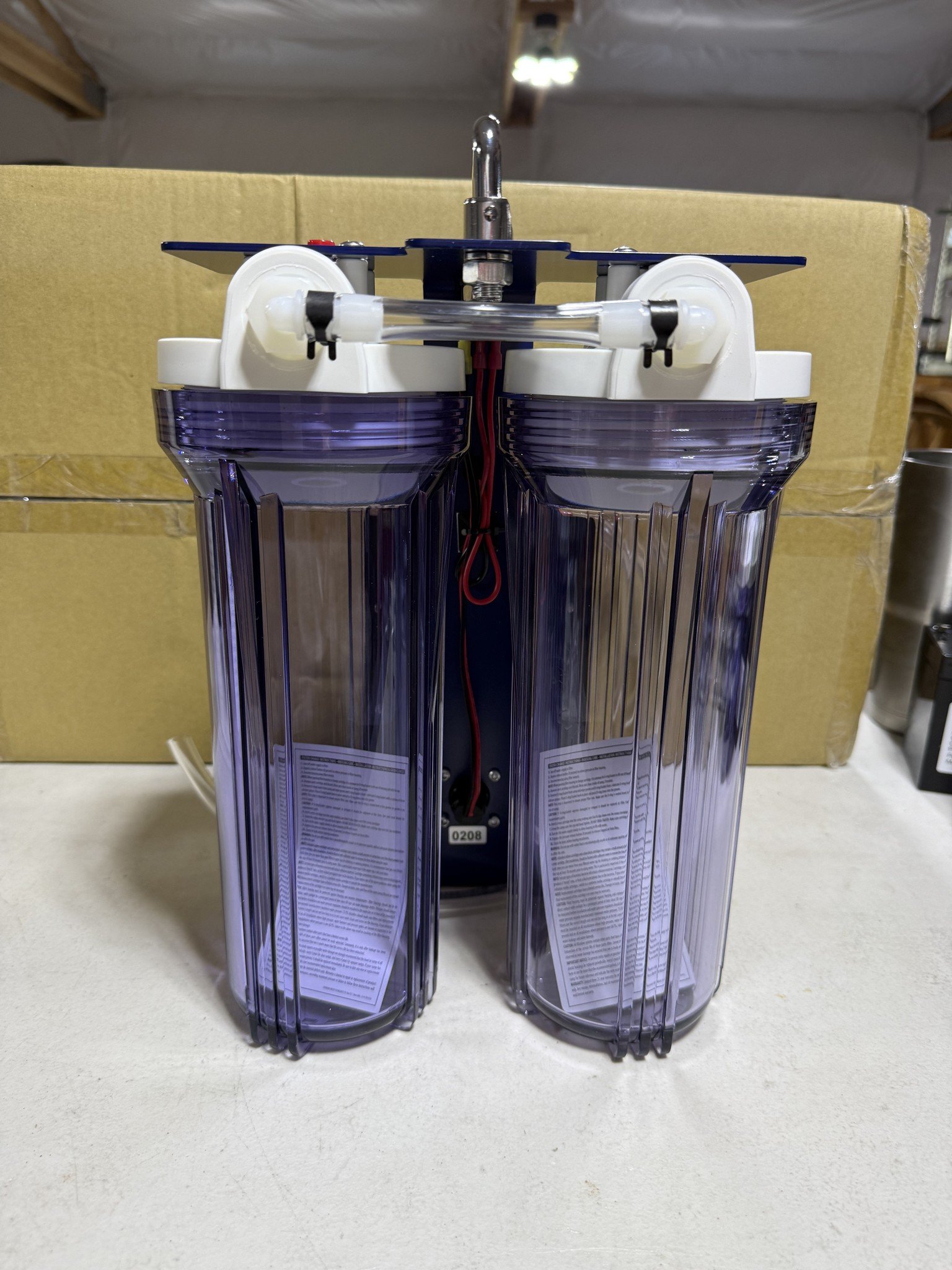
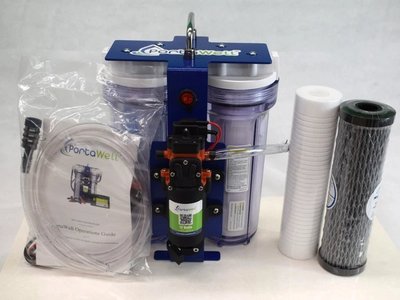
The PortaWell MINI uses two standard cartridge housings. Cartridge choice is covered in [choosing the right water filters](https://myportawell.com/learn/choosing-the-right-filters/); this article is about the treatment order, not a specific cartridge claim.
Contact time is the catch.
- Organism: Giardia — Filtration: A tight, tested filter is the usual first step — Chlorine (household bleach): Unreliable; slow, worse in cold water — Chlorine dioxide: About 30 minutes — UV light: Effective in clear water
- Organism: Cryptosporidium — Filtration: A tight, tested filter is the usual first step — Chlorine (household bleach): Ineffective — Chlorine dioxide: About 4 hours — UV light: Very effective in clear water
- Organism: Bacteria — Filtration: Filter first, then disinfect — Chlorine (household bleach): Effective within the standard 30-minute wait — Chlorine dioxide: Effective in minutes — UV light: Effective in clear water
- Organism: Viruses — Filtration: Most cartridge filters are not a complete treatment — Chlorine (household bleach): Effective within the standard 30-minute wait — Chlorine dioxide: Effective in 15–30 minutes — UV light: Effective in clear water
Cold water slows every chemical disinfectant. As a rough rule, the reaction rate halves for every 18°F (10°C) drop in temperature, so a dose that works in a warm reservoir may fall short in a snowmelt stream. Filtration does not care about temperature.
The practical lesson: filtration is the primary first step against protozoa, because chemicals either work poorly or take hours. Chemicals and UV are the usual finishers for bacteria and viruses.¹¹
Why filter first. The order matters, for four reasons:
- Filtration reduces what chemicals handle poorly. Giardia and Cryptosporidium are addressed before the disinfectant ever has to deal with them.
- Clear water makes dosing predictable. Sediment and organic matter consume chlorine before it reaches the organisms, and particles can shield them. In raw water, chlorine demand varies widely, so any dose is a guess. In filtered water, a standard dose works more predictably. Step-by-step bleach doses are in chlorine for emergency water treatment.
- Fewer byproducts. Chlorine reacting with organic matter forms byproducts that are regulated as long-term health risks. That is a secondary concern in an emergency, but filtering first avoids most of it anyway.
- UV needs clear, low-color water. Particles block the light, and dissolved tannins absorb it even when the water looks clear. Filtration reduces cloudiness, and a carbon cartridge can help with color.
Choosing a finisher.
Chlorine is the finisher most people will have, in the form of household bleach. It is cheap, and it leaves a residual that keeps protecting stored water. Its weaknesses are taste, poor performance against protozoa (which the filter is meant to address first), and slower action in cold water. Most households will not have chlorine dioxide, and with a solid filter in front, they often do not need it.
UV adds no chemicals or taste and works in seconds against a wide range of organisms, including Cryptosporidium, when the water is clear. It needs power and clear water, and it leaves no residual, so treated water can be recontaminated by a dirty container or hands. For 12V power options, see powering a 12V PortaWell water filter. The official Use Solar with PortaWell Short, and the PortaWell YouTube channel, show field power setups.
Boiling remains the most reliable method of all, at the cost of fuel and time.
Putting it together:
- Remote water with no known human activity upstream: filtration is the foundation; adding disinfection is the more conservative choice, especially for children, older adults, or anyone with weakened immunity.
- Human activity upstream, floodwater, or disaster conditions: filter, then disinfect with chlorine, UV, or boiling.
- Stored water: a chlorine residual protects it, or store it clean and run it through the filter before use.
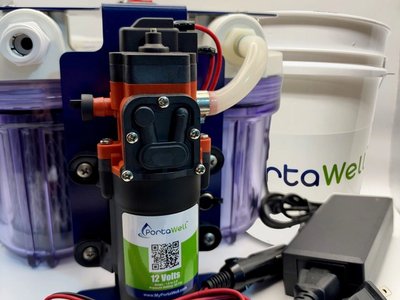
For source-to-container steps, see filtering river, creek, and pond water. For keeping cartridges in service, see how long water filters last. A broader buying overview is in the portable water filter buyer's guide. The Ready-to-Run MINI kit adds a wall adapter, a 12V car cable, and a 5-gallon bucket to the MINI.
Bottom line
Illness from waterborne pathogens is neither as random nor as inevitable as it can seem. A few principles cover most of what matters:
- These organisms do not multiply in clean water. They survive, sometimes for months, and slowly die off. Contamination comes from somewhere, and stored water does not grow germs on its own.
- Risk depends on the organism, the dose, and the person. The toughest common organisms, Giardia and Cryptosporidium, are also among the most infectious, and children, older adults, and anyone with weakened immunity are most vulnerable.
- What's upstream matters. Wildlife and livestock bring protozoa and bacteria. Human waste adds viruses.
- Filtration is the foundation. It is the usual first step against protozoa, which chemicals handle poorly or take hours to finish, and it clears the water so disinfection works.
- Disinfection is the finisher. When people may have contaminated the water, follow the filter with chlorine, UV, or boiling.
FAQ
What are waterborne pathogens?
Waterborne pathogens are disease-causing organisms that spread through untreated or poorly treated water. In the United States, nearly all waterborne illness comes from protozoa, bacteria, and viruses. Giardia and Cryptosporidium are the toughest common protozoa. Risk depends on which organism is present, how many you swallow, and who is drinking, especially children, older adults, and anyone with weakened immunity.
Can you get sick from clear untreated water?
Yes. Clear water is not automatically finished water. Giardia and Cryptosporidium are invisible, so the clearest mountain stream can still carry waterborne pathogens. What's upstream matters more than how the water looks. Wildlife and livestock can add protozoa and bacteria; human waste also adds viruses.
Can a portable water filter remove waterborne pathogens?
A tight, tested cartridge filter is a strong first step against larger organisms such as protozoan cysts, but it is not a complete treatment for every waterborne pathogen. PortaWell does not claim virus reduction and does not remove salt or dissolved solids. For untrusted water, or any source that may have human contamination, filter and then disinfect.
Why should I filter water before adding bleach?
Filter first because sediment and organic matter use up chlorine and can shield waterborne pathogens. Filtering also addresses Giardia and Cryptosporidium, which chlorine handles poorly or not at all. In filtered water, a standard bleach dose works more predictably. In raw, cloudy water, any dose is closer to a guess.
What waterborne illness do Giardia and Cryptosporidium cause?
Giardia and Cryptosporidium cause diarrheal waterborne illness, often with cramps, gas, or fatigue. Both can cause sickness from as few as ten cysts, and they survive for weeks to months in cold water. Chlorine is unreliable against Giardia and ineffective against Cryptosporidium, which is why filtration comes first and a second disinfection step may still be needed.
Does stored water grow bacteria in a sealed container?
A clean, sealed jug does not grow disease-causing waterborne pathogens by itself. Those organisms need a host and a source of contamination. The usual changes in old stored water are flat taste or harmless slime from a dirty or warm container. The real risk is later handling, or refilling from a questionable source.
What should I do if I get sick from untreated water?
The immediate concern is dehydration from diarrhea and vomiting. Keep drinking treated water or an oral rehydration solution made with sugar, salt, and 1 liter of treated water. Seek medical care for bloody diarrhea, high fever, little or no urine, dizziness, confusion, symptoms lasting more than a week, or illness in an infant or frail older adult.
Sources
- Context on waterborne helminths and rare U.S. liver-fluke cases is from standard public-health references in Robert's original notes.
- Survival times for Giardia and Cryptosporidium in cold water are summarized from the public-health literature cited in the source draft.
- Low infectious doses for Giardia and Cryptosporidium: U.S. FDA, Bad Bug Book, 2nd edition, 2012, also covers incubation times and illness descriptions (note 5).
- CDC guidance on Naegleria fowleri and the nasal-exposure route.
- U.S. FDA, Bad Bug Book, 2nd edition, 2012.
- World Health Organization, Cholera outbreaks (29 September 2026). The homemade oral rehydration recipe of 6 level teaspoons of sugar and half a level teaspoon of salt in 1 liter of treated water.
- Collier et al., Estimate of Burden and Direct Healthcare Cost of Infectious Waterborne Disease in the United States, Emerging Infectious Diseases, 2021.
- Gerdes et al., Estimating Waterborne Infectious Disease Burden by Exposure Route, United States, 2014, Emerging Infectious Diseases, 2023.
- Mac Kenzie et al., A Massive Outbreak in Milwaukee of Cryptosporidium Infection Transmitted through the Public Water Supply, New England Journal of Medicine, 1994.
- Hoxie et al., Cryptosporidiosis-Associated Mortality Following a Massive Waterborne Outbreak in Milwaukee, Wisconsin, American Journal of Public Health, 1997.
- CDC, Water Treatment Options When Hiking, Camping or Traveling. Current CDC guide for field treatment options; it replaces the older backcountry-treatment URL in the source draft.