How to Turn Surface Water Into Safe Drinking Water: A 5-Step Guide
PortaWell Admin
Author
When clean water stops coming out of the tap, the water around you — a stream, a pond, a swimming pool, collected rain — can still become safe drinking water. But it takes more than running it through a filter. Filtration is one step in a five-step process, and skipping the steps around it is where most people go wrong.
This guide is a practical overview for anyone preparing for an emergency, heading off-grid, or simply wanting to understand how portable water treatment actually works. We'll walk through the whole process at a high level, and link out to detailed guides on each step as we publish them.
The 5 Steps at a Glance
- Selecting your water source — start with the cleanest water you can find.
- Gathering — collect it with the least sediment and contamination possible.
- Pre-treatment — let debris settle out before it ever reaches your filter.
- Filtration and treatment — remove sediment, pathogens, and contaminants.
- Safe storage and sanitation — keep clean water clean.
Here's the key principle that ties them together: the dirtier your starting water, the harder every later step becomes.Effort you spend early — finding a better source, settling out debris — pays off in longer filter life and safer water at the end.
Step 1: Selecting Your Water Source
Your choice of water source has an outsized impact on how much work the rest of the process takes. Finding the cleanest available water is one of the most important decisions you'll make — even if that source is a little harder to reach or collect from. The dirtier the water, the more effort every later step requires.
It also helps to know how to "read" water — and how to test it — so you understand what contaminants or pollutants you're dealing with before you start.
Common surface water sources, roughly cleanest to dirtiest:
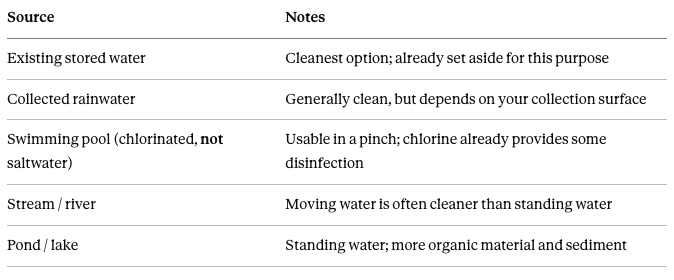
Water source table
A note on salt water: Seawater and brackish water (a mix of fresh and salt) can't be made drinkable by filtration alone. Removing salt requires desalination — either distillation or reverse osmosis — which is a different, more involved process and beyond what a portable filtration system like PortaWell is designed to do.
Plan ahead. Whenever possible, identify and prioritize your water sources before an emergency — and actually run through these five steps end to end at least once. Practicing turns an unfamiliar, stressful task into a known, confident routine.
Step 2: Gathering
How you collect water depends on your source, but the goal is always the same: capture as little sediment, debris, and contamination as possible.
First, think about transport. In many situations it makes sense to carry the untreated water back to camp or your vehicle and filter it there, where you have your equipment and clean containers ready. This also removes any chance of contaminating your clean water on the trip back.
The obvious move — scooping from the edge of a pond or slow stream into a bucket — is also the most problematic. Water at the edge is usually shallow and still, so scooping close to the bottom picks up sediment and organic matter.
A better approach is to draw water from a deeper spot, about 8–10 inches below the surface while staying well above the bottom. The challenge is doing that without wading in and stirring up the very sediment you're trying to avoid. One option is to extend your collection point away from shore — for example, a cordless submersible transfer pump (such as Milwaukee's M12 stick pump) can draw from a chosen depth without disturbing the bottom. If clean collection isn't possible, plan on pre-treatment to remove what you couldn't avoid picking up.
Step 3: Pre-Treatment
Pre-treatment is an optional step that depends on your water quality and how cleanly you gathered it. Often it's as simple as letting the water sit in your collection container for a few minutes — up to about 30 — before filtering. Heavier debris settles to the bottom, and you draw the clearer water off the top.
For very cloudy or turbid water, a commercial flocculant made for drinking-water clarification can help pull fine particles together so they settle out; follow the manufacturer's dosage and settling instructions.
Ultra-fine strainers made for 5-gallon containers (with mesh as fine as 25 microns) are another option, though they're not always effective — especially with water that's heavily colored or full of organic debris.
Don't chlorinate yet. Adding chlorine at this stage is counterproductive: chlorine reacts with organic debris to form unwanted byproducts, and dirty water demands a higher chlorine dose to work. Filter out the organic material first, then disinfect afterward if desired.
Step 4: Filtration and Treatment
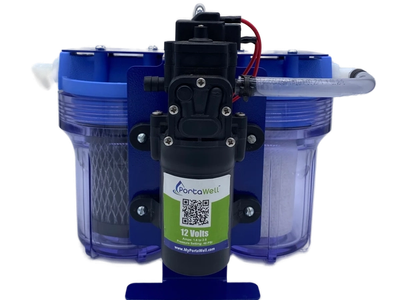
This is the step most people picture when they think about making water drinkable — and where your PortaWell system does its work. But it's worth being precise about the roles: PortaWell is the appliance; the filters do the contaminant removal.
We don't manufacture filters. We designed PortaWell to accept standard-sized, non-proprietary, commercially available filters, so you're never locked into a single supplier. In our own testing, the Argonide NanoCeram filter performs exceptionally well for this application.
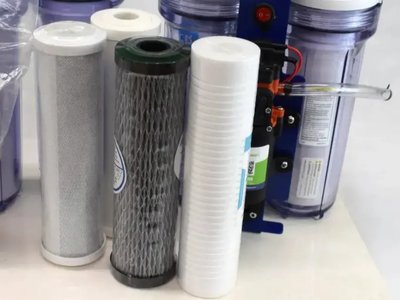
Every PortaWell system uses at least two stages:
- Stage 1 — Sediment filter (typically 1 micron): Removes as much sediment and debris as possible before the water reaches the second stage, protecting the finer filter and extending its life.
- Stage 2 — NanoCeram filter (0.2 micron, pleated): A high-surface-area filter that captures fine sediment and pathogens including protozoa (Giardia, Cryptosporidium) and many viruses.
As noted earlier, the cleaner your source water — and the more suspended material you remove before this step — the longer your filters last before flow restriction tells you it's time to replace them.
Two habits worth building:
- Discard the first gallon each time you use the system — both the very first use and after any period of storage.
- Filter into a clean, sterilized container. All the effort above is wasted if the destination is dirty.
Do You Still Need to Disinfect After Filtering?
This deserves a clear answer, because it's where safety guidance and product marketing often blur together. Public health agencies, including the CDC, note that most portable filters do not reliably remove viruses, and they recommend adding a chemical disinfectant (chlorine, chlorine dioxide, or iodine) — or boiling — after filtering questionable water. A 0.2-micron electroadsorptive filter like the NanoCeram addresses far more of the viral load than a typical mechanical filter, but if your source is high-risk or you want maximum assurance, a final disinfection step is a reasonable and inexpensive addition. We'll cover exactly when and how in a dedicated follow-up post.
Step 5: Safe Storage and Sanitation
All the work above can be undone in seconds by recontamination, so this final step is about discipline as much as equipment.
Keep the clean side clean. Unless you're filtering directly at the point of use, store filtered water in food-grade containers with secure lids, sanitized periodically. Never let filtered water come into contact with unfiltered source water, and treat everything on the source-water side of your process — containers, tubing, and your hands — as microbially unsafe. You don't need to be a germaphobe; you do need common sense about cross-contamination.
Why the caution? The microbial risk of surface water varies enormously with the source and its surroundings, and you generally can't tell whether water is safe just by looking at it. Evaluating the source and its likely contamination is what tells you how much pre-treatment and treatment it needs.
Sanitizing your equipment. A diluted chlorine solution around 200 ppm works well on appropriate surfaces. Remove the filter cartridges first, spray down the components (never the filters), allow adequate contact time, then drain and air-dry. Sanitize clean-water storage containers the same way.
As a rule of thumb, clean and dry the system whenever you expect more than about 48 hours between uses. For shorter gaps, just empty the housings, wipe the unit down, and store it safely until next time.
Preparing for Long-Term Storage
For longer storage, here's the routine we use:
- Briefly run the system dry to purge most of the water from the housings (this won't harm the pump).
- Empty any remaining water, remove the filters, and set them out to air-dry.
- Wipe residual water from the canisters and gently shake out the tubing and internals.
- Let everything air-dry thoroughly — warm, dry conditions speed this up.
- Store the filters separately from the canisters. This prevents moisture in the filters from condensing inside closed housings.
- Store components in a clean, cool, dry location.
In our experience — particularly with the NanoCeram cartridge — repeated wetting and drying hasn't caused visible structural damage or noticeable loss of performance. Before reusing, reinstall the filters, then flush and discard the first gallon.
Putting It All Together
Turning surface water into safe drinking water isn't about owning one magic device — it's about doing five steps well: choosing a clean source, gathering carefully, pre-treating, filtering through the right stages, and protecting your clean water afterward. Get the early steps right and the whole process gets easier, safer, and cheaper.
PortaWell is built to make the filtration step reliable and repeatable — using standard, replaceable filters you can source anywhere. Explore the PortaWell system or see the selection guide.
Frequently Asked Questions
Can you drink river or pond water after filtering it? Filtering removes sediment, protozoa, and bacteria, and a NanoCeram-equipped system also reduces many viruses. For high-risk sources or maximum assurance, health agencies recommend adding a disinfection step (chlorine, chlorine dioxide, or boiling) after filtering.
Can PortaWell filter seawater or salt water? No. Removing salt requires desalination (distillation or reverse osmosis), which filtration alone can't do. PortaWell is designed for fresh surface water.
How long do the filters last? It depends heavily on how dirty your source water is. The cleaner the water and the more sediment you remove before filtering, the longer the filters last before flow restriction signals it's time to replace them.
Do I need to pre-treat the water? Not always. If your water is clear and you gathered it cleanly, letting it settle briefly may be enough. Cloudy or debris-heavy water benefits from settling, a flocculant, or a pre-filter before treatment.
Should I chlorinate before or after filtering? After. Chlorinating dirty water wastes disinfectant and can create unwanted byproducts. Filter out organic material first, then disinfect if desired.
References and Further Reading
For readers who want to go deeper, these authoritative sources informed this guide:
- CDC — How to Make Water Safe in an Emergency. Federal guidance on treating questionable water, including why filtration and disinfection are often used together. cdc.gov/water-emergency
- U.S. EPA — Emergency Disinfection of Drinking Water. Detailed instructions for boiling and chemical disinfection, with chlorine dosing guidance. epa.gov/ground-water-and-drinking-water
- CDC — About Choosing Home Water Filters. Explains filter pore-size ratings and what different filters do and don't remove (bacteria, parasites, viruses). cdc.gov/drinking-water
- World Health Organization — Household Water Treatment and Safe Storage Following Emergencies and Disasters. International guidance on treating and safely storing water when normal supplies are disrupted. who.int
- Argonide — The NanoCeram Advantage. The manufacturer's explanation of how NanoCeram's electropositive (electroadsorption) media captures bacteria, viruses, and cysts despite a 0.2-micron rating, and how the PAC version adds activated carbon for chlorine and organics. argonide.com
- NASA Spinoff — Nanofiber Filters Eliminate Contaminants. An independent account of the NASA-supported research behind NanoCeram nanoalumina fiber media and its measured effectiveness against sub-micron particles, bacteria, and viruses. spinoff.nasa.gov
This is general preparedness guidance. Actual water safety depends on your specific source and conditions.