Packaged Reverse Osmosis Limits for Emergency Kits and Overlanding
PortaWell Admin
Author
A packaged reverse osmosis (RO) unit is a poor primary system for a family emergency kit. For overlanders it is at best a supplement. It can improve taste and reduce some dissolved contaminants that a cartridge filter misses, but it is not a complete treatment system on its own. This article covers the limits that apply to small packaged RO units, why storage and recovery are especially hard in an emergency kit, and the narrow role RO can play on the road.
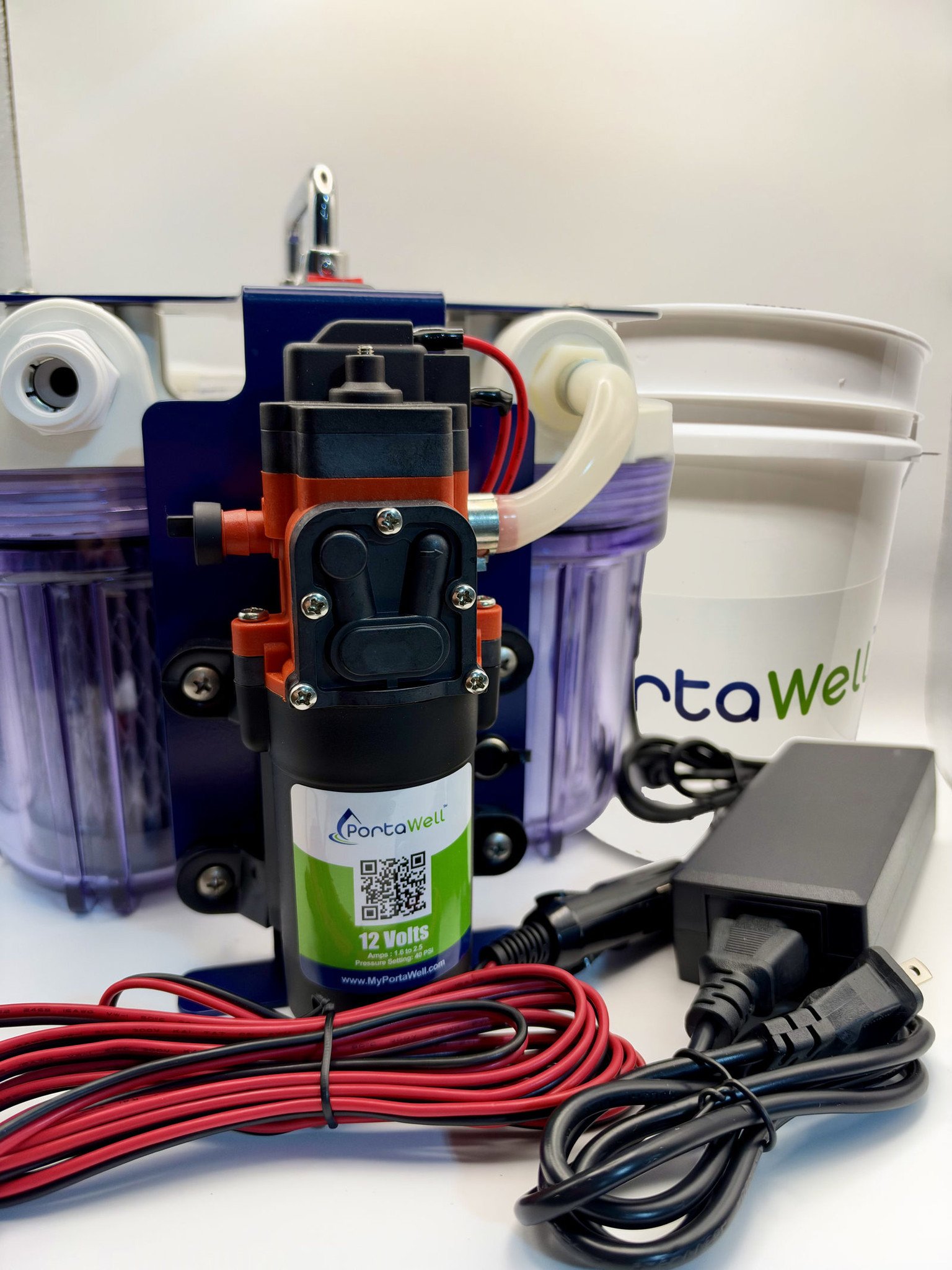
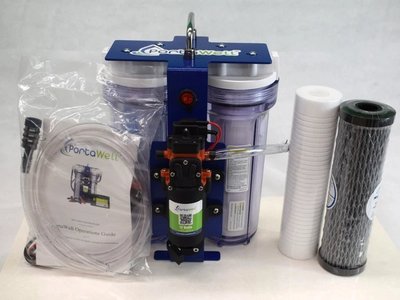
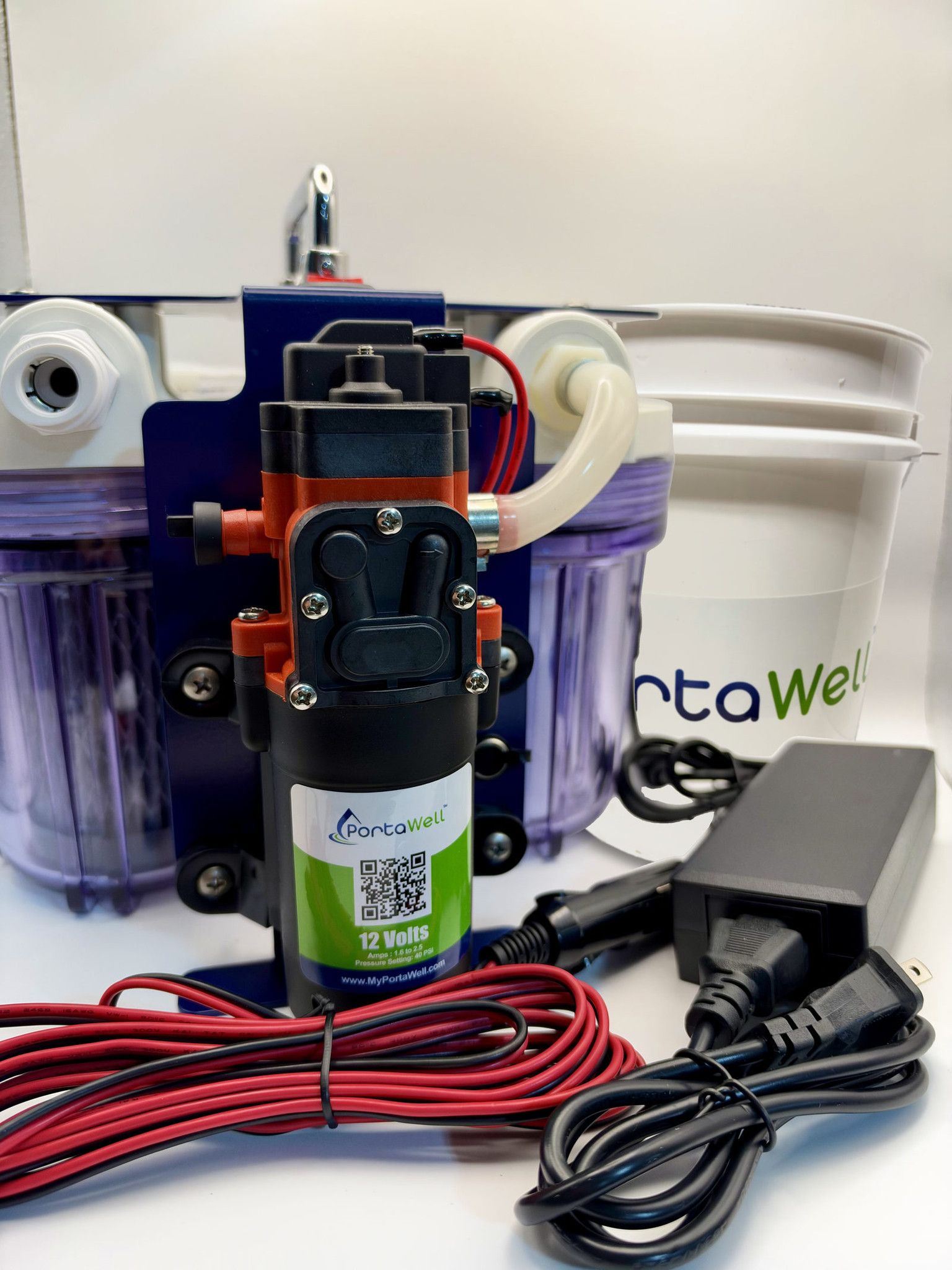
The PortaWell MINI is a 12V cartridge filter, not a packaged reverse osmosis unit. The Ready-to-Run kit adds a wall adapter, a 12V car cable, and a 5-gallon bucket.
Limits that apply to most packaged RO systems
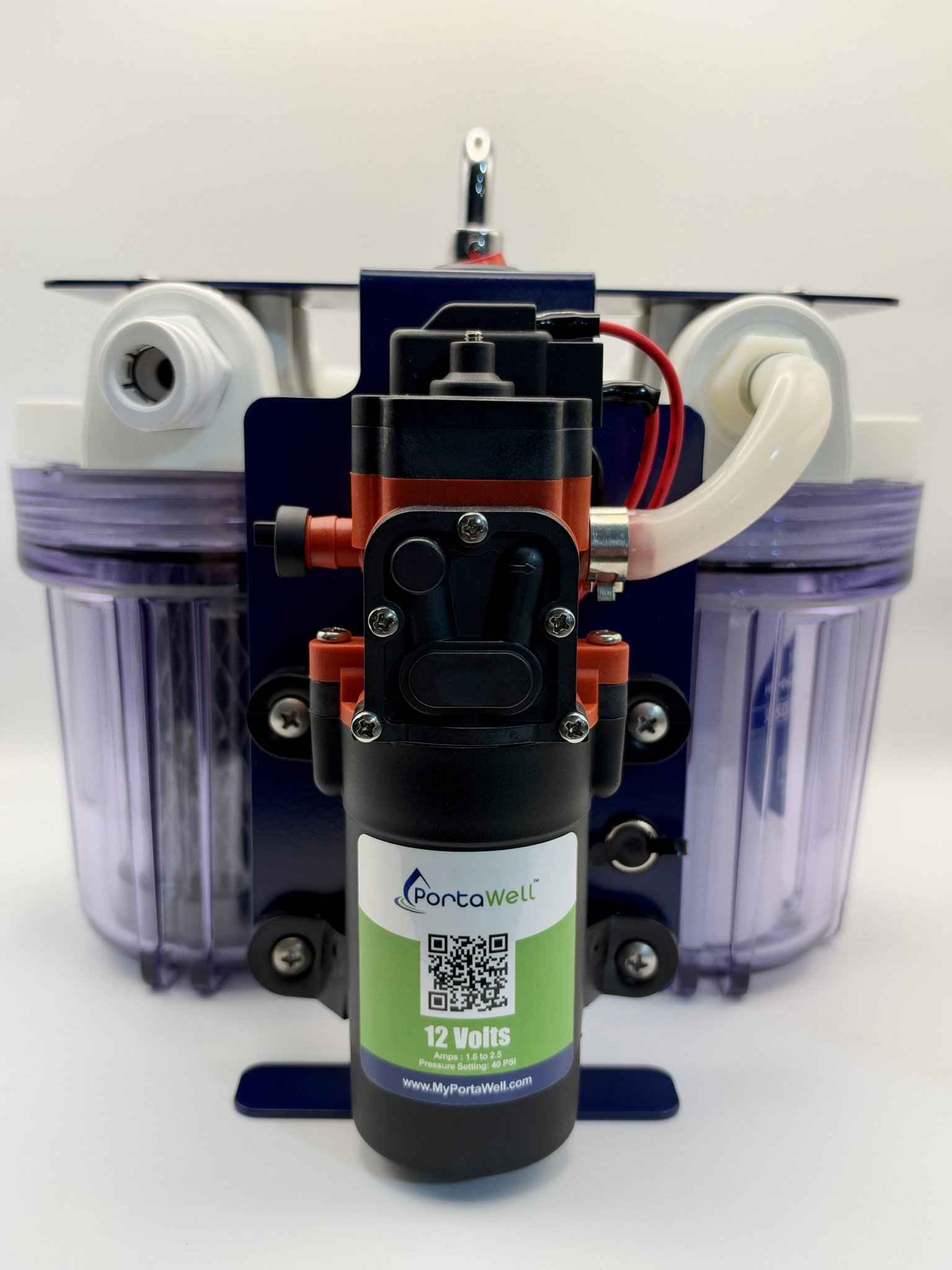
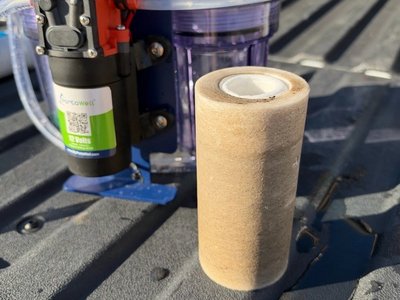
A PortaWell MINI 12V cartridge filter. Unlike a packaged RO unit, it uses standard filter cartridges and does not rely on a storage-sensitive membrane.
Feed water quality. Packaged units are designed for water that is already reasonably clean. Their small built-in prefilters clog quickly on cloudy surface water, and the membrane fouls next. Free chlorine, as in some municipal supplies or chlorinated pool water, damages standard thin-film membranes unless a carbon stage removes it first. For pool-water limits in an emergency, see the pool-water article.
Reject ratio. Small units typically recover only about 20 to 30 percent of their feed water, so making one gallon of product water takes three to five gallons of feed. Pushing recovery higher can scale the membrane, especially on hard Western water. The reject stream can be used for washing, but it is not finished water.
Slow output. Label ratings of 50 to 400 gallons per day are about packaged RO units, not PortaWell, and they usually assume warm water (about 77°F) at full feed pressure. Cold water and a 12V pump can cut real output substantially. Filling a container often takes many minutes, not seconds.
Consumables. Prefilters, carbon blocks, and eventually membranes all need replacing, and the cartridges are often proprietary. Off-brand replacements may not fit.
Freezing. Water trapped in the membrane and housings can damage them below freezing.
Not a complete treatment barrier. Household RO units are typically listed for reducing dissolved contaminants. That kind of listing is not a complete treatment barrier for untreated or untrusted water. Seals and O-rings can leak, so you still need to disinfect afterward.
Why packaged RO is a poor fit for a family emergency kit
Storage. Once a membrane has been wetted, it has to be kept wet and preserved, and it cannot freeze. A unit that is tested and then shelved is likely ruined. The only reliable approach is a factory-sealed spare membrane, opened only when needed, and even then it has a limited shelf life.
Limited water. With hauled or stored water, the reject ratio multiplies the work: 20 usable gallons can mean starting with about 80 gallons of feed.
Silent failure. A membrane that fails in storage can look exactly like a good one. The problem shows up only when the unit is put into use, at the worst possible time. A TDS meter can catch a sudden jump in dissolved solids, but only if someone thinks to check.
For a family emergency kit, any one of those problems (storage, recovery ratio, or feed-water quality) is serious. Together they make a packaged RO unit a poor primary system.
Packaged RO for overlanding: where it helps and where it still falls short
For overlanders, some objections soften. A unit used every few days can stay wet, the vehicle charging system can provide power, and the feed is often tap or campground water rather than a muddy creek. Even then, questionable municipal water abroad can be contaminated in the distribution system (broken lines, a low disinfectant residual, or problems between the plant and the tap). A household RO unit is not a complete barrier for that. The water still needs disinfection. Filtration plus disinfection already does that job without RO.
That leaves packaged RO a narrow supporting role: reducing dissolved contaminants, minerals, and off-tastes that a cartridge filter misses. It also adds a risk of its own. RO strips out any chlorine residual, so product water stored in an onboard tank has no leftover disinfectant, and pleasant-tasting water can invite false confidence.
Weak spots that remain for overlanders:
- Limited onboard tank capacity. Every gallon of reject is water you carried or have to replace.
- Space and weight in a vehicle already packed with gear.
- Slow fills that keep you at a water stop longer.
- Truly raw sources. When the only water is a stream, the feed-water problem returns in full, and you need a filtration front end anyway. See Filtering River, Creek and Pond Water.
- Winter storage in an unheated vehicle.
If you are choosing a 12V filter for camping or overland travel rather than an RO add-on, start with the PortaWell MINI or the Ready-to-Run MINI kit, which adds a wall adapter, a 12V car cable, and a 5-gallon bucket. The MINI overlanding article covers how the MINI is used on the road.
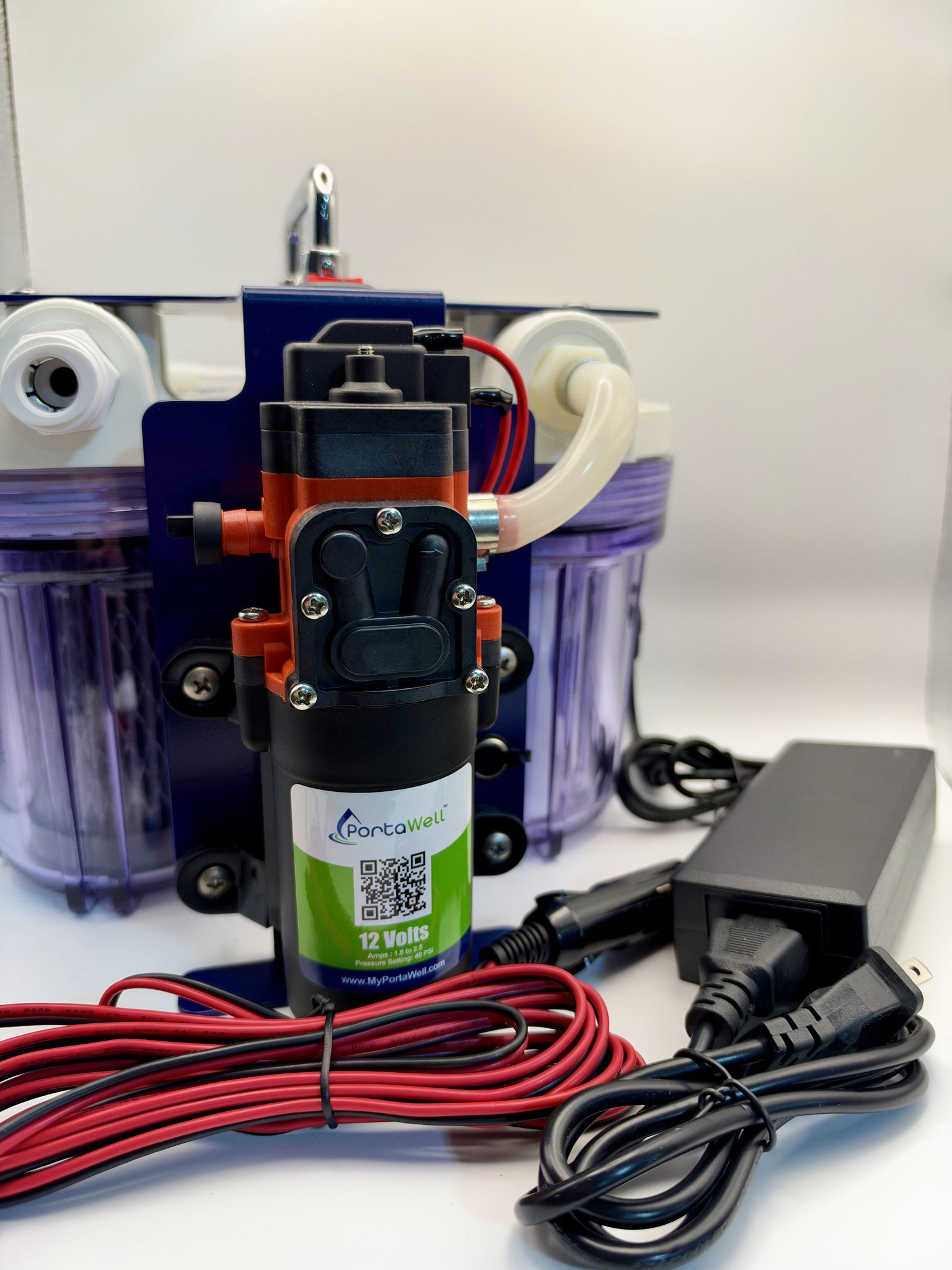
The Ready-to-Run MINI includes the 12V wall adapter and the vehicle 12V cable, so you can run the filter from household power or a 12V socket.
What PortaWell filtration does and does not replace
PortaWell is built by a family business in Hooper, Utah. It is a 12V cartridge filter, not a reverse osmosis system. That difference matters. PortaWell does not remove salt or dissolved solids, so it is not a desalination tool. What it is built for is moving water from a lake, river, tank, or other source through standard filters. Filtration is still only one step; pair it with disinfection when the source is untrusted.
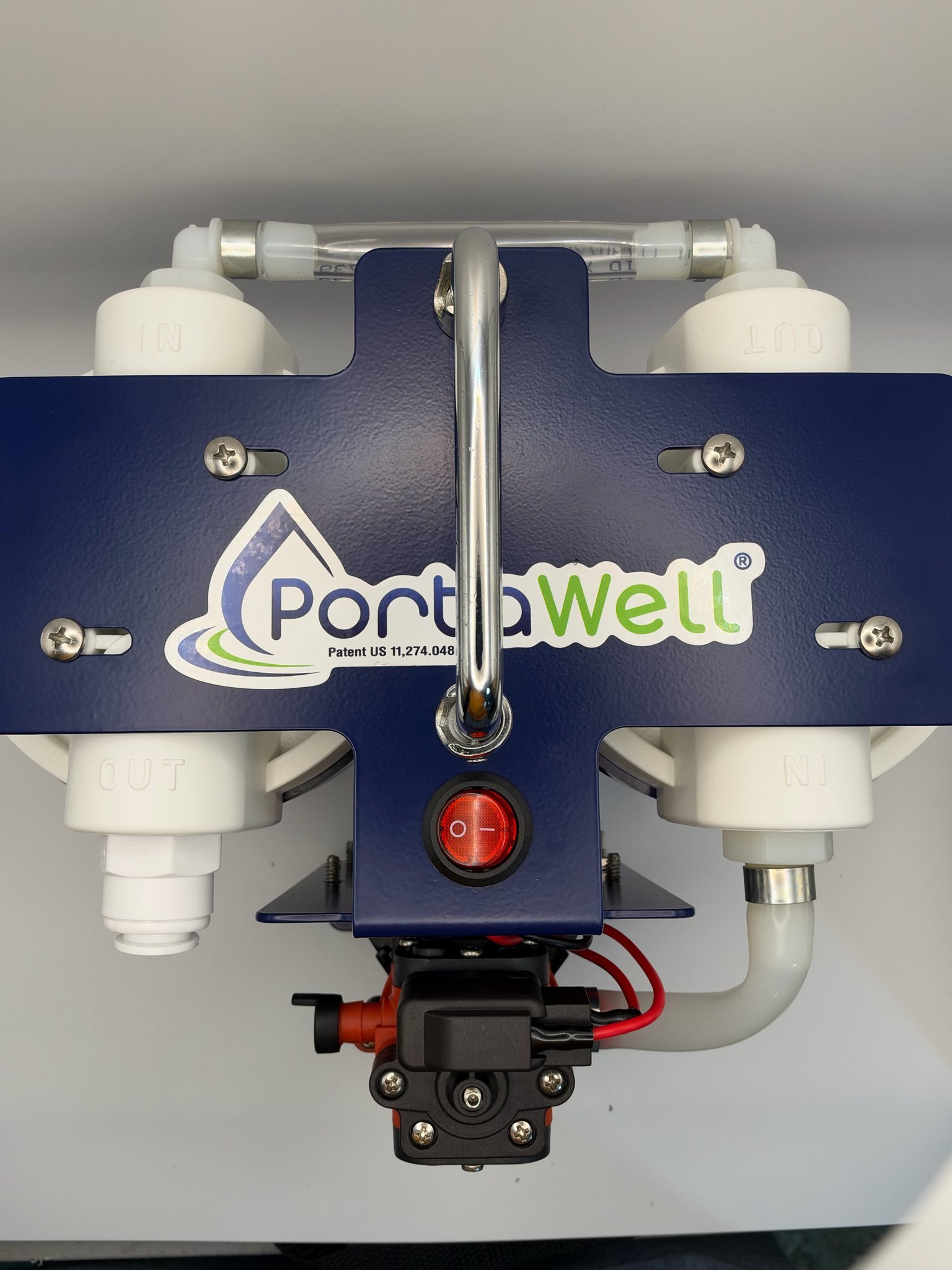
Top of the PortaWell MINI: two standard filter housings, labeled inlet and outlet, and the 12V pump switch. This is a cartridge filter, not a reverse osmosis membrane stack.
For how the 12V pump is powered, see Powering Your PortaWell. That page also includes a short official video, Use Solar with PortaWell, showing a 12V battery and panel hooked up to the pump. For how packaged RO compares with other portable types, see the portable water filter guide. More PortaWell setup videos are on the official PortaWell YouTube channel.
Packaged reverse osmosis FAQ
Can I use a packaged RO system as my only emergency water system
No. A packaged RO unit is a poor primary system for a family emergency kit because of storage, the reject ratio, and feed-water quality. You still need filtration and disinfection for untrusted water.
Why does a small RO unit waste so much water
Small units typically keep only about 20 to 30 percent of the feed as product water. The rest goes to the reject line. That is normal for this class of unit. Raising recovery too far can scale the membrane, especially on hard water.
Can I store an RO unit long term after I test it
Not reliably. Once the membrane is wetted, it has to stay wet, preserved, and above freezing. A unit that is tested and then shelved is likely ruined. A factory-sealed spare membrane, opened only when needed, is the more realistic spare, and it still has a limited shelf life.
Does PortaWell replace reverse osmosis
No. PortaWell does not remove salt or dissolved solids. RO can reduce those. Use the PortaWell MINI or the Ready-to-Run MINI kit as a 12V cartridge filter, then disinfect untrusted water. Treat packaged RO as an optional extra for taste and dissolved contaminants only if you can feed it reasonably clean water and accept the reject volume.
Is packaged RO useful for overlanding
Sometimes, as a supplement, when you use it often enough to keep the membrane wet and you are feeding relatively clean tap or campground water. It is not the treatment barrier, and it is a poor fit for muddy creeks, tight tank volume, or an unheated vehicle in winter.
Can I run a packaged RO unit from a 12V battery
Some small units can run from a 12V pump or power source, but cold water and 12V pressure often cut output well below the label rating. Budget extra time at the water stop, and size the battery for the pump you actually have.
Bottom line
For a family emergency kit, a packaged RO unit fails on storage, recovery ratio, and feed water, and each alone is a serious problem. For overlanders, it is an optional add-on for dissolved contaminants and taste, never the complete treatment barrier. In both cases, untrusted water still needs filtration and disinfection.