Can You Filter Pool Water to Drink? Steps and Limits
PortaWell Admin
Author
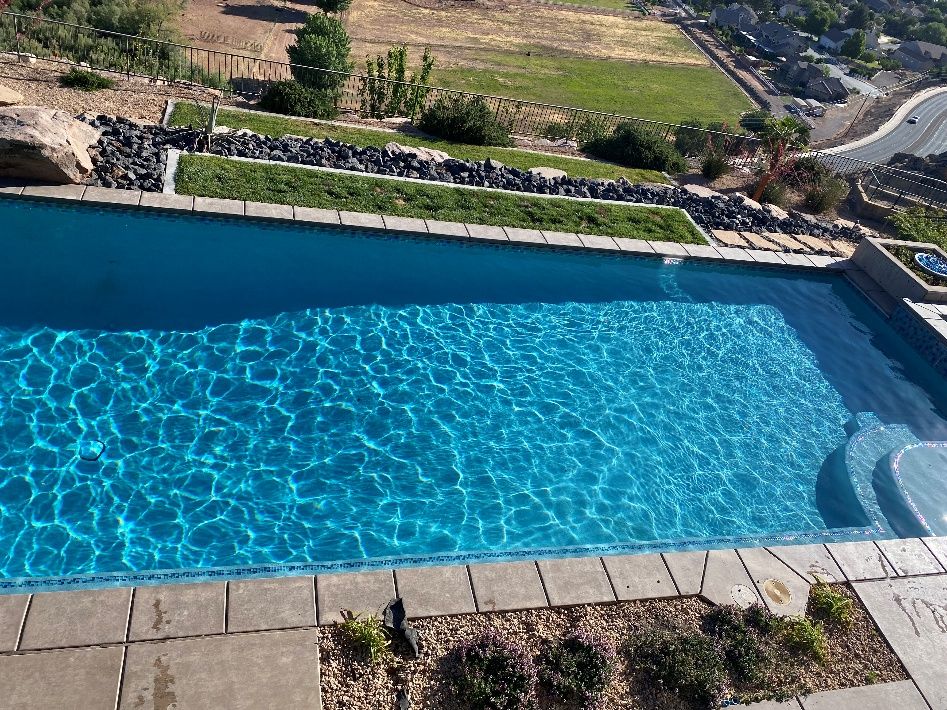
Short answer: it depends on the pool. A chlorine-sanitized freshwater pool whose treatment history you know is the best candidate to filter pool water for drinking in a grid-down emergency, using three stages: sediment, NanoCeram, then AquaMetix or activated carbon. Saltwater, borate and bromine pools are excluded because filtration cannot remove salt, boron or bromine.
Disclosure: PortaWell Systems sells the filtration system and cartridges discussed in this article.
Why consider your pool as an emergency water source
In an extended grid-down event, the nearest rivers, ponds, canals, or lakes are often miles away and of unknown quality, and sewage overflows, runoff, spills, or flooding can make them worse over time. A residential pool is close by and holds thousands of gallons, yet official guidance says not to drink it.
This guide treats a pool as a raw water source to be evaluated, not ruled out. Whether a pool qualifies depends on what is known about its chemistry and condition (see Appendix C).
Can you filter pool water to drink? It depends on the type of pool
Pools fall into three groups:
- Excluded pools contain something filtration cannot remove, such as salt, boron, or bromine, or have been contaminated by sewage, fuel, or chemicals. Use them only for cleaning and flushing.
- Included pools are chlorine-sanitized freshwater pools whose treatment history you know. These are the best candidates.
- Not-excluded pools are freshwater pools whose history is unknown or incomplete. They are not ruled out, but you must judge them using the additive guide in Appendix A.
For included and not-excluded pools, this guide offers a practical treatment method. The resulting water is not guaranteed safe, but it is a lower risk than the realistic alternatives: distant surface water of unknown quality, or no water at all.
Excluded: saltwater, borate and bromine pools
Three common systems leave dissolved contaminants that ordinary filtration cannot remove:
- Saltwater pools (chlorine generators). Dissolved salt passes through every filter stage. Removal requires reverse osmosis or distillation.
- Borate-treated pools. Boron levels far exceed the WHO 2.4 mg/L guideline. Filtration does not remove boron.
- Bromine-sanitized pools (primarily spas). Bromine and its byproducts are not addressed by the filter train.
Pools contaminated by sewage, fuel, or chemical spills are also excluded.
Included: chlorinated freshwater pools with a known history
A freshwater pool sanitized with chlorine, whose treatment history you know, is an included source. Ideal conditions are a solid opaque cover already in place, CYA managed in the 40–60 ppm range, and a simple record of products added. Muriatic acid used for pH control does not leave a residual contaminant of concern.
These pools are the clearest candidates for treatment and use as a drinking water source.
Not excluded: pools with an unknown treatment history
Pools with unknown treatment history are not automatically excluded. Many common additives break down, settle out, or pose low risk after ordinary treatment. Others persist or accumulate. Appendix A lists frequent additives, whether they persist, whether a homeowner can test for them, and the practical implication. Use your best judgment whether non-excluded pool water qualifies for your specific usage.
How to filter pool water for drinking with PortaWell
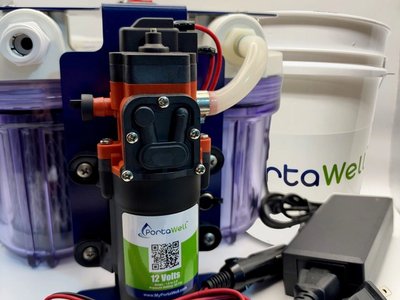
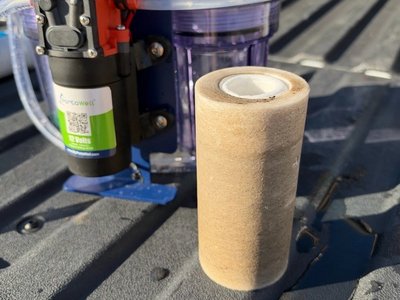
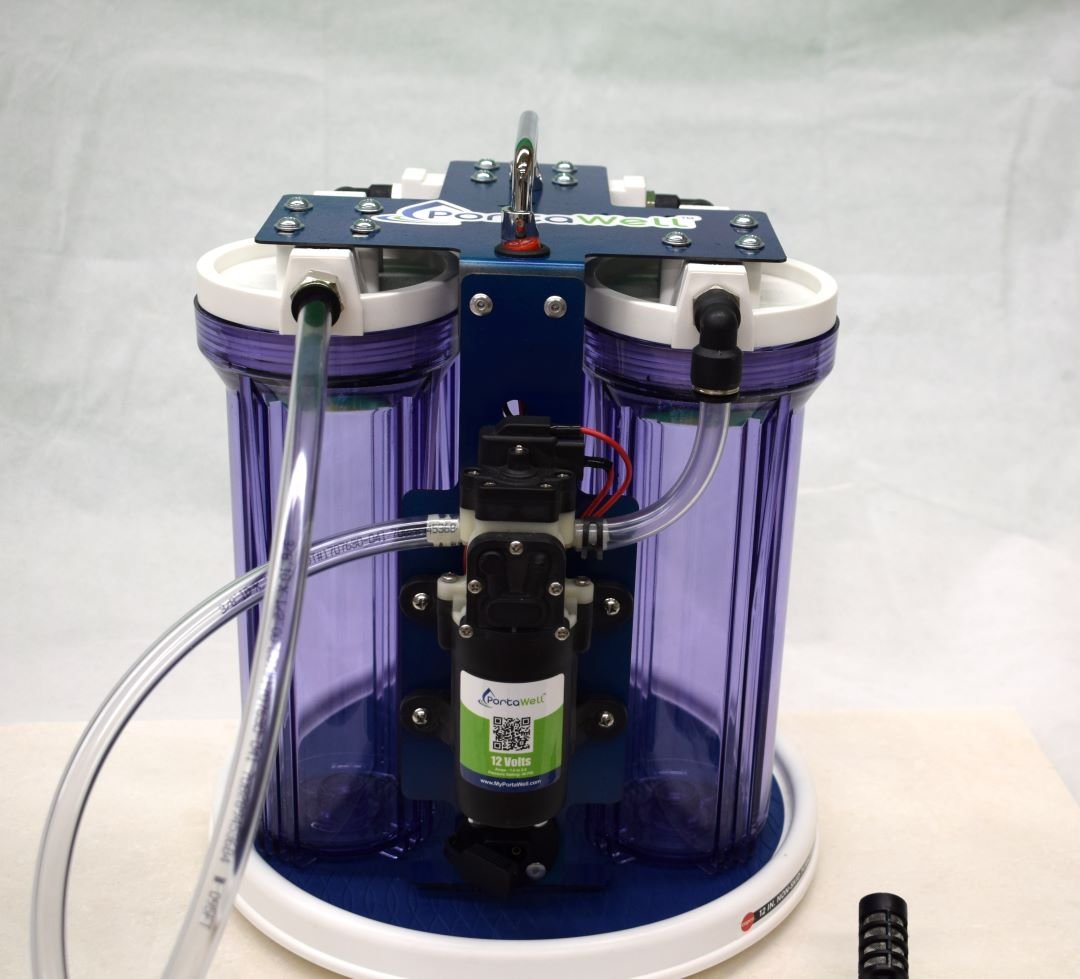
Clear water from an included or not-excluded pool is treated in three stages: sediment filter, then NanoCeram filter, then AquaMetix or activated carbon filter. Filter only what you drink or cook with. Pool water can be used as is for cleaning, laundry, toilet flushing. This three-stage filtration can use the PortaWell Triple in a single pass or the Duo in two passes by changing filters between treatments.
For pool use, the PortaWell Pool Triple System runs the sediment, NanoCeram and AquaMetix stages in one pass, and the PortaWell Pool Plus Kit adds an activated carbon block for a fourth stage.
- Draw from the clearest area with the intake suspended below the surface and well above the floor.
- If particles are visible, settle the batch covered and draw off the clear upper water.
- AquaMetix filter is preferred with any algaecide history; activated carbon is usually adequate for a known chlorine-only pool. Neither stage removes salt, boron, or CYA.
- For water that will be stored for an extended time, best practice is to chlorinate after filtering. Water used in near term does not require it.
- Store in clean, covered containers. Pour, do not dip.
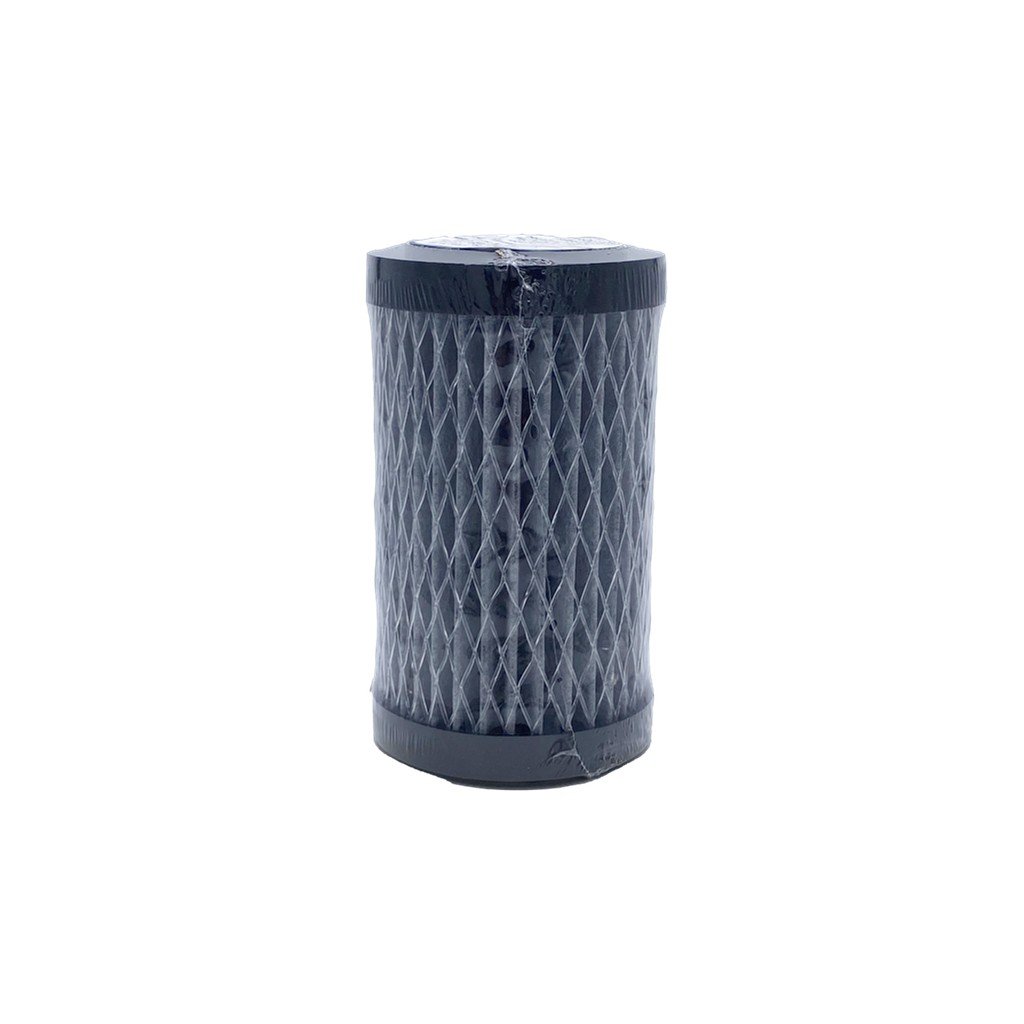
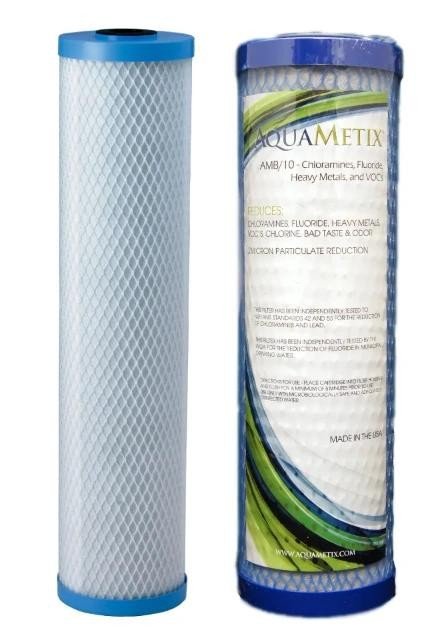
For more on picking the third stage, see Activated Carbon vs AquaMetix and Choosing the Right Filters.
Is cyanuric acid (CYA) in pool water a problem?
Cyanuric acid is a common additive to most pools and acts as a chlorine stabilizer. CYA can build up over time and the only method to reduce its concentration is to partially or completely drain and refill the pool.
WHO lists 40 mg/L (40 ppm) as a lifetime drinking-water guideline. The value comes from a 2-year rat study plus the standard 100-fold uncertainty factors and a lifetime 2 L/day assumption. There is no human data behind it. Government chemical guidelines in general are set for continuous long-term exposure and chronic effects; they are not acute emergency limits.
Many well-run pools operate at 40–60 ppm of CYA concentration. At those levels CYA stabilizes chlorine (especially useful on an uncovered pool) and remains usable for emergency periods of weeks to months. Dilution toward the lower end is preferable when easy, particularly for children, but 50–60 ppm undiluted is not grounds to discard the pool when the alternatives are no water or distant surface water of unknown microbial quality. Military field standards similarly accept higher short-term chemical levels than civilian lifetime guidelines because the immediate risks of dehydration or contaminated water are larger.
- Under ~60 ppm: usable as-is after filtration.
- Above 60 ppm: dilute when practical (partial drain-and-refill beforehand or blend with rain or snowmelt). The blend still receives full treatment.
- Dilution does not rescue saltwater or borate pools.
How to keep your pool ready as an emergency water source
Many pools are maintained by professionals. Communicate these secondary requirements so the pool is ready:
- Use plain granular calcium hypochlorite (Cal-hypo, 65–73% available chlorine). Avoid trichlor or dichlor once CYA is above 60 ppm; both add CYA with every dose.
- If your pool uses an automatic feeder with liquid chlorine (sodium hypochlorite), keep using it; like cal-hypo, it adds no CYA.
- Keep CYA in the 40–60 ppm range.
- Maintain a simple log of products added (brand and active ingredient), recent free chlorine, pH, CYA, and calcium hardness, plus any partial drains. Many pool stores will test a sample for free.
- If a solid opaque cover is already present, plan to use it. Adding one later is a major project, not an emergency step.
- Stock cal-hypo, a simple pool chemistry test kit (FAS-DPD), CYA test strips, food-grade drums, a transfer pump, and spare PortaWell cartridges.
- The PortaWell Pool Survivor Kit is a spares kit for 10-inch systems, with 16 filters, a maintenance kit and a spare 12V pump.
Plan power for the pump too: see Powering Your PortaWell.
How long does pool water last when the pump stops?
A covered pool with a maintained residual can stay usable for months. An uncovered pool usually turns within weeks.
Covered pool
Put the solid opaque cover on as soon as the outage looks long. It blocks light, protects chlorine, and keeps debris out. Maintain 1–3 ppm free chlorine by dissolving cal-hypo in a bucket of pool water, pouring it around the perimeter, and stirring. Brush walls and floor a few times a week. Skim debris and remove any drowned animals immediately. Fill clean drums early and label them SOURCE WATER — TREAT BEFORE USE.
Uncovered pool
Follow the same hand-dosing, brushing, and debris steps. Expect faster chlorine loss and a shorter usable window. The 40–60 ppm CYA range helps hold the residual. Treat the pool as a shorter-term source and use other water when you have it.
In freezing climates, cold suppresses algae, but protect plumbing from freeze damage without adding antifreeze to the water.
How to chlorinate filtered pool water for storage (cal-hypo dosing)
Make a 500 mg/L stock: one heaping teaspoon (about ¼ oz) of granular 70 % cal-hypo in two gallons of water. Add the stock to clear filtered water:
Table 1—Drinking water dosing amounts.
Final volume: 1 gallon. Stock to add: 1 ¼ fl oz. or: 2 ½ Tbsp
Final volume: 5 gallons. Stock to add: 6 fl oz. or: 3/4 cup
Final volume: 10 gallons. Stock to add: 13 fl oz. or: 1 5/8 cup
Double the added volume if the water is cloudy, cold, or from a higher-CYA pool. Stir, wait 30 minutes, and confirm a slight chlorine smell. Boiling works for small amounts if fuel is available; it is not practical as the main method.
More background: Water Treatment with Chlorine for Drinking Water.
Can you use pool water with algae?
An algae bloom does not automatically end use of the pool. The default is to treat only the water needed, batch by batch (how settling and particulate removal work).
- Draw from the clearest water, away from scum and walls. Do not brush immediately before drawing.
- Settle overnight in a clean covered drum and skim any floaters.
- Decant the clear upper water and filter as above.
- Do not chlorinate the raw batch.
When to stop: signs of cyanobacteria and the jar test
Stop using the pool for drinking if you see thick paint-like scum or floating mats, a strong septic or grassy odor, or a dying bloom (brown, white, or bluish with foul smell), as this may indicate a cyanobacteria bloom. An overnight jar test (clear jar three-quarters full from just below the surface, left undisturbed) gives a first indication: green settled at the bottom is most likely ordinary algae; a green ring at the top suggests cyanobacteria—do not shock the pool. Drink only filtered water from a bloom that the jar test indicates is ordinary green algae. Water suggesting cyanobacteria should be reserved for non-drinking use (KDHE jar test instructions).
Keep records, test what you can, and give the best water to children. This method reduces risk relative to untreated surface water; it cannot guarantee safe water from every pool in every condition.
Pool water vs. river or pond water in an emergency
Table 3—Raw water source comparison
Factor: Disease-causing microbes. Maintained, covered pool: Low at the start; chlorinated. River, pond or reservoir: Wildlife, livestock and human sewage are common sources
Factor: Turbidity and organic matter. Maintained, covered pool: Low. River, pond or reservoir: Often high, and higher after storms
Factor: Agricultural and industrial chemicals. Maintained, covered pool: Normally none. River, pond or reservoir: Runoff and upstream discharges are possible
Factor: Known chemistry. Maintained, covered pool: Yes: you added it. River, pond or reservoir: Unknown
Factor: Change during a grid outage. Maintained, covered pool: Slowly gets worse without the pump. River, pond or reservoir: Can get worse quickly as sewage systems fail
Factor: Distance. Maintained, covered pool: Your backyard. River, pond or reservoir: Often a haul, and water weighs about 8.3 lb. per gallon
Factor: Volume. Maintained, covered pool: Typically, 15,000–30,000 gallons. River, pond or reservoir: Large, but shared
A pool's main remaining risk is chemicals from known products like chlorine, cyanuric acid (CYA) and anything else you have added. Natural or wild sources carry the risks that make people sick fastest: Giardia, Cryptosporidium and bacteria.
For natural sources, see From Surface Water to Drinking Water.
Pool water FAQ
Can you filter pool water to drink?
For included pools (chlorine-sanitized freshwater with a known treatment history) and not-excluded pools, this guide's method uses three stages: sediment, NanoCeram, then AquaMetix or activated carbon. The resulting water is not guaranteed safe, but it is a lower risk than distant surface water of unknown quality or no water at all.
Can you filter water from a saltwater pool?
No. Dissolved salt passes through every filter stage. Removal requires reverse osmosis or distillation. Use saltwater pool water only for cleaning and flushing.
Does filtering remove chlorine stabilizer (CYA)?
No. Neither the AquaMetix nor the activated carbon stage removes salt, boron, or CYA. Under about 60 ppm CYA, water is usable as-is after filtration; above 60 ppm, dilute when practical.
Can you boil pool water to drink?
In this method, boiling works for small amounts if fuel is available, but it is not practical as the main method. For filtered water you plan to store, chlorinate with a cal-hypo stock using Table 1.
What can you use pool water for without filtering?
Pool water can be used as is for cleaning, laundry and toilet flushing. Filter only what you drink or cook with.
Can you still use a pool that has algae?
An algae bloom does not automatically end use of the pool. Settle, decant and filter batch by batch. Stop using it for drinking if you see signs of cyanobacteria, such as thick scum, floating mats or a green ring at the top of a jar test.
Do health agencies approve drinking pool water?
No. Official guidance says not to drink it, and no agency has validated the full procedure as a pool-to-drinking-water method. This guide treats a pool as a raw water source to be evaluated, not ruled out.
Can you make pool water drinkable?
Not with certainty. For included and not-excluded pools, this guide's method uses three stages: sediment, NanoCeram, then AquaMetix or activated carbon, which the PortaWell Triple can run in a single pass. The resulting water is not guaranteed safe, but it is a lower risk than distant surface water of unknown quality or no water at all. Saltwater, borate and bromine pools are excluded. The PortaWell Pool Triple System is built around the sediment, NanoCeram and AquaMetix order.
Can you make salt water pool water drinkable?
No. Dissolved salt passes through every filter stage, and removal requires reverse osmosis or distillation. Borate-treated pools are also excluded because filtration does not remove boron. Use these pools only for cleaning and flushing.
Can you make chlorinated pool water drinkable in an emergency?
A freshwater pool sanitized with chlorine, whose treatment history you know, is an included source and the clearest candidate for treatment. Ideal conditions are a solid opaque cover, CYA in the 40 to 60 ppm range and a simple record of products added. Filter only what you drink or cook with, and chlorinate after filtering if the water will be stored for an extended time. More background is in Chlorine for Emergency Water Treatment: Dosing Guide.
Can you filter swimming pool water to drink in a grid-down emergency?
In an extended grid-down event, the nearest rivers, ponds, canals or lakes are often miles away and of unknown quality, while a swimming pool is close by and holds thousands of gallons. Official guidance says not to drink pool water, so this guide treats a pool as a raw water source to be evaluated, not ruled out. A covered pool with a maintained residual can stay usable for months, and an uncovered pool usually turns within weeks.
About PortaWell
PortaWell is a family-owned small business in Utah. Its powered 12V portable filtration systems are designed, fabricated and assembled in the USA for times when treated municipal water isn't available and other sources must be used: a third lane between gravity filters and hand filters. The systems use standard, non-proprietary filters and are field-repairable. Learn more about PortaWell, compare options in the Portable Water Filter Guide, or watch setup and filtering videos on YouTube @myportawell.
The power to make clean water, when it matters most.
Appendix A: Additives to Consider for a Not-Excluded Pool
Table 2—Pool additives risk
Additive: Quat algaecides (foaming type). Persistence: Slowly consumed. Home test: Foam test (indicator). Health risk: Low. Irritant at high doses. Practical implication: Filter through AquaMetix or carbon
Additive: Polyquat (non-foaming “60” type). Persistence: Persistent. Home test: No. Health risk: Low, poorly studied. Large polymer, poorly absorbed. Practical implication: Prefer other water if recently dosed; otherwise use AquaMetix
Additive: Copper algaecides, ionizers. Persistence: Accumulates. Home test: Yes. Health risk: Moderate if accumulated. Stomach upset first. Practical implication: Measure copper; usable below about 1 ppm
Additive: Silver or zinc mineral cartridges. Persistence: Accumulates. Home test: Limited. Health risk: Low short-term. Practical implication: Treat like copper
Additive: Sodium bromide (“yellow-out” treatments). Persistence: Persistent until drained. Home test: Indirect. Health risk: Moderate. Forms brominated byproducts with chlorine. Practical implication: Effectively turns the pool partly into a bromine pool
Additive: Clarifiers: polyDADMAC, chitosan, alum. Persistence: Settle out, vacuumed away. Home test: No. Health risk: Low after settling. Practical implication: Low concern
Additive: Lanthanum phosphate removers. Persistence: Mostly precipitate out. Home test: No. Health risk: Low. Poorly absorbed. Practical implication: Low concern
Additive: Metal sequestrants (phosphonates). Persistence: Persistent. Home test: No. Health risk: Low directly. Practical implication: Hold metals in solution, making metals harder to remove
Additive: Enzymes, ascorbic or citric acid stain removers. Persistence: Break down. Home test: No. Health risk: None meaningful. Practical implication: Benign
Additive: Non-chlorine shock (potassium monopersulfate). Persistence: Leaves sulfate. Home test: Yes, TDS meter. Health risk: Low to moderate. Sulfate is laxative at high levels. Practical implication: Adds dissolved solids; interferes with DPD chlorine readings. TDS above about 1,000 suggests old pool water
Additive: Borax used to raise pH. Persistence: Persistent. Home test: Strips exist. Health risk: Low occasionally; moderate if habitual (boron). Practical implication: A small dose is fine; a habit leads toward borate-pool territory
Table note: Typical maintenance copper in pools is often below EPA’s drinking-water action level of 1.3 mg/L, and copper sulfate is used as an algaecide in drinking-water reservoirs. Pool copper test kits exist. The real problems are accumulation from repeated dosing, chelated copper being harder to reduce, and corroding heat exchangers adding copper even where no algaecide was used.
Disclaimer: Health risk is the relative risk from drinking the water for weeks to months after PortaWell treatment. Ratings are judgments from general toxicology, not measured data for pool water. Entries describe preferences when you have a choice; when the alternative is no water, treated pool water is the better risk.
Appendix B: Cyanobacteria
Most backyard-pool blooms after an outage are ordinary green algae. Cyanobacteria are possible where nutrients have entered. Most toxin stays inside intact cells, and breaking them releases it, so do not shock a suspected bloom. Because there is no published removal data for this filter train against cyanotoxins, water from a suspected cyanobacteria bloom, or any bloom with thick scum, mats, or a dying bloom, should be used for non-drinking use only. Children should receive the best alternate water available.
Appendix C: Basis for the claims
Claims rest on published guidance and manufacturer data. No agency has validated the full procedure as a pool-to-drinking-water method.
Relative risk. Dilute residual chemicals (CYA at 40–60 ppm, trace metals or additives that survive treatment) present low acute risk over weeks to months. Acute dehydration becomes life-threatening within days. Microbial contamination from untreated surface water (Giardia, Cryptosporidium, bacteria, sewage-related pathogens) can cause illness within days. In the grid-down setting the chemical residuals from an included or not-excluded pool may present a smaller risk compared with no water or with distant surface water of unknown microbial quality.
Government guidelines. Chemical guideline values are set for continuous, long-term exposure. They are derived to protect against chronic effects over a lifetime of daily intake and incorporate substantial uncertainty factors, especially when based on animal studies. They are not acute or short-term emergency limits.
U.S. military exposure guidelines (USACHPPM TG 230, referenced in TB MED 577) set chemical limits for 7-day, 14-day, and up-to-1-year drinking periods. With few exceptions, they are equal to or less conservative than the corresponding long-term standards. The rationale is that immediate risks of dehydration or contaminated water outweigh the smaller long-term risk from a temporary elevation.
Certified means an accredited body verified a claim against a published standard; tested means a lab measured it. Chlorine decay rates remain estimates. Clear water, normal flow, taste, or smell do not confirm that every dissolved chemical or toxin has been reduced.
Appendix D: Sources
- CDC emergency water guidance.
- EPA emergency disinfection and cyanotoxin treatment summaries.
- WHO sodium dichloroisocyanurate, boron, and microcystin fact sheets.
- U.S. military USACHPPM TG 230, referenced in TB MED 577 and related NATO field water standards.
- Kansas Department of Health and Environment jar test.
- New York State Department of Health pool chemical storage notes.
- Manufacturer data for NanoCeram and AquaMetix.
All checked October 2026.