Drinking Water After Nuclear Fallout
PortaWell Admin
Author
Quick answer: After fallout, the biggest personal water win is usually stored water + time, not rushing to pump from open sources. Radiation intensity drops fast at first (the classic 7–10 rule). When you do treat surface water: settle → filter (PortaWell with NanoCeram PAC + AquaMetix) → optionally disinfect for microbes → verify with a meter. No consumer filter is “radiation-free.”
Important: Educational preparedness content based on published radiation-safety references. Not official emergency guidance. Follow FEMA, CDC, and local authorities in a real event. PortaWell does not claim to produce radiation-free water.
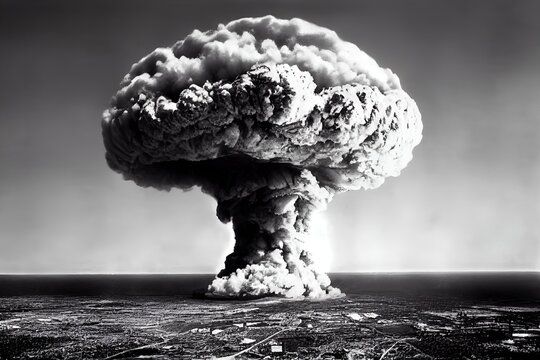
After a nuclear event, the harder problem for most people isn’t the flash—it’s securing drinkable water in the days that follow.
When people picture nuclear emergencies, they imagine mushroom clouds and mass destruction—but the more likely personal danger isn’t the flash, it’s what comes afterward: finding safe water. Radioactive fallout can contaminate open sources within minutes, yet accurate information about “radioactive water” is scarce and often sensational. This guide takes a practical, science-based look at what really happens, what can be done about it, and how a properly designed filtration system—like PortaWell—fits into the survival timeline.
In this guide
- What happens after detonation
- Is tap water safe after a nuclear blast?
- Fallout chemistry in water
- How PortaWell fits
- Recommended emergency supplies
- Wait, gather, filter, verify
- Imperfect water vs dehydration
- Why stored water wins early
- Phased survival framework
- FAQ
- References
1. The scenario: what happens after detonation
A nuclear detonation or dirty bomb releases fission products into the atmosphere—microscopic particles of metal, oxide, and salt that fall back to earth as “fallout.” If you’re within the blast range, the immediate radiation pulse dominates. For everyone else downwind, the hazard arrives hours later as dust settles on soil, roofs, and water.
The good news: radioactivity decays rapidly.
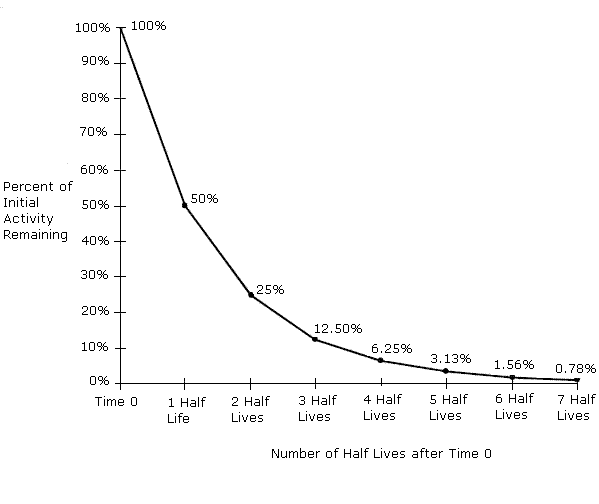
The classic 7–10 rule (Glasstone & Dolan, The Effects of Nuclear Weapons, 1977)
After 7 hours, radiation intensity drops to about 10% of its initial (1-hour) value; after about 2 days, to roughly 1%. Within a month, the short-lived isotopes that cause most of the early external dose have largely faded. Water-safety risk therefore changes over time—severe in the first two days, moderate by day five, and mostly a longer-term chemical/cleanup issue after several weeks.
Timeline strategy: store early → wait → then filter.
Is tap water safe after a nuclear blast?
Usually treat municipal tap as untrusted until officials say otherwise. A blast or dirty bomb can disrupt treatment plants, break pipes, and allow fallout dust into open reservoirs and distribution. Even if the tap still runs, clarity is not a safety test.
Practical order of preference:
- Sealed stored water you set aside before the event (best early option)
- Official guidance from your utility, CDC, FEMA, or local emergency management
- If you must use open or questionable water later: wait → settle → filter → verify with a meter (and disinfect for microbes if needed)
Boiling alone does not remove dissolved radionuclides. Pitcher filters and fridge cartridges are not designed for fallout. A PortaWell stack with NanoCeram PAC and AquaMetix is for risk reduction when stored supplies run low—not a guarantee of radiation-free tap water.
2. Fallout chemistry: what’s actually in the water
Radioactive fallout isn’t one substance. It’s a mixture of dozens of isotopes. The three that matter most for drinking-water risk are cesium-137, strontium-90, and iodine-131 (UNSCEAR 2000).
Isotope: I-131. Half-life: 8 days. Behavior: Soluble iodide/iodate. Main concern: Thyroid (short-term)
Isotope: Cs-137. Half-life: 30 years. Behavior: Soluble Cs⁺ (~potassium). Main concern: Long-term gamma
Isotope: Sr-90. Half-life: ~29 years. Behavior: Soluble Sr²⁺ (~calcium). Main concern: Bone uptake
After the fireball cools, cesium forms soluble hydroxides and chlorides; strontium forms hydroxide, carbonate, and sulfate salts; iodine appears as cesium iodide or iodide anions (IAEA TRS-472). Roughly a quarter of the total may become soluble in water, another half binds to soil and dust particles, and the rest locks into glassy mineral beads that are largely inert.
Contaminated water is thus a mix of suspended fallout dust plus dissolved salts—and both respond to physical and chemical filtration strategies.
3. How PortaWell fits the physics
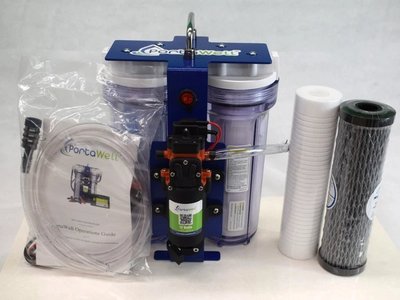
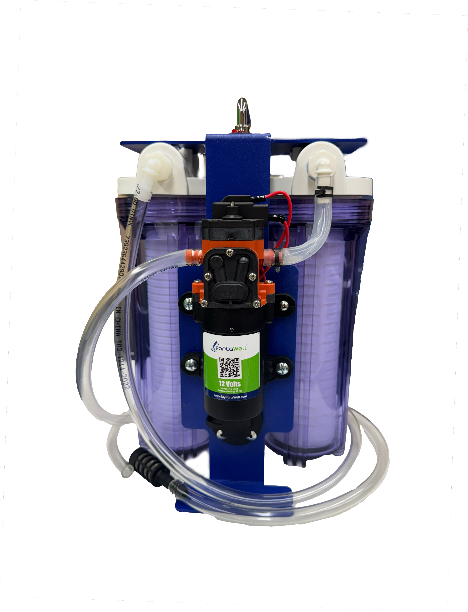
Portable water filters are often rated only for microbes or sediment, but radiation adds a second challenge: ionic contaminants. A dual-stage PortaWell stack aimed at this problem pairs particle capture with ion-exchange/adsorption media.
Stage 1 — NanoCeram® PAC
Shop: 10" NanoCeram PAC · 5" NanoCeram PAC (MINI)
A composite of electropositive alumina nanofibers and powdered activated carbon (PAC).
- Attracts and traps negatively charged particles and colloids, including fallout dust and soil fines
- Reduces turbidity and many biological contaminants per the media’s design
- Helps capture radioactive particles such as Cs- or Sr-bearing dust (literature/manufacturer-class particle capture often cited above ~95% for fine particulates—confirm current filter documentation)
Stage 2 — AquaMetix®
Shop: 10" AquaMetix
A blend of carbon block plus mixed-metal-oxide and ion-exchange media.
- Exchanges ions with Cs⁺ and Sr²⁺, chemisorbs iodide/iodate anions, and adsorbs many trace metals
- Typical removal ranges cited for this class of media / test conditions:
- Cs-137 ≈ 85–95%
- Sr-90 ≈ 90–97%
- I-131 ≈ 85–95%
Combined, such a stack can reduce total radioactivity in typical fallout-affected water by an order of magnitude or more in favorable conditions—enough to turn many unsafe surface sources into practical survival water (see IAEA TECDOC-1753). No consumer filter can promise “radiation-free.” The goal is massive risk reduction per gallon.
4. Recommended emergency supplies
Preparedness works best when layered—each layer buying time for the next.
Stored water
- Minimum 15–30 gallons per person (≈ one month at ~½ gallon/day for drinking and minimal cooking)
- Food-grade containers, kept cool and sealed
Filtration & treatment
- PortaWell dual- or triple-stage system with spare filters: NanoCeram PAC 10", AquaMetix 10", and sediment 10" for silty water
- Spare filters and a spare pump in one box: Survivor Kit (10-inch systems) or MINI Survivor Kit
- Systems: Starter Pak · Triple System · MINI
- Chlorine source for biological disinfection (calcium hypochlorite powder or unscented household bleach)
Measurement & monitoring
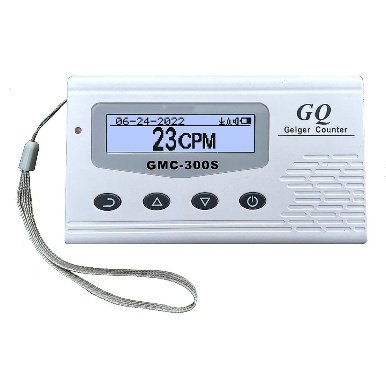
- Handheld radiation meter (example class: GQ GMC-300S, roughly $80–$100)
- Detects gamma + beta; displays µSv/h or CPM
- Spare batteries or a small power bank
Support gear
- Two clean buckets (settling + collection), funnel, storage jugs
- Nitrile gloves; heavy-duty bags for used filters
- Notebook or phone notes for readings and dates
5. Practical approach: wait, gather, filter, verify
Step 1 — Wait
Staying put for the first day or two after fallout is more than radiation avoidance—it’s natural decontamination.
- Radioactive decay: Intense short-lived emitters fade on hour-to-day timescales. Within ~48 hours, overall gamma activity in fallout often drops ~90% from the 1-hour post-detonation value.
- Chemical transformation: Early soluble salts react with carbonates, sulfates, and clays, forming less mobile minerals (Coughtrey & Thorne 1983).
By ~72 hours, total activity is usually much lower and more of the contamination is particle-bound—so settling and filtration work better.
Step 2 — Settle
Once fallout deposition has slowed, skim water from just below the surface of a suitable surface source. Let it stand 12–24 hours. Pour only the clearer upper layer into the filter intake.
Step 3 — Filter
Run settled water through PortaWell. In silty conditions, use a sediment pre-filter to protect NanoCeram media.
Triple tip: Put a 1-micron sediment filter in stage 1 to prolong NanoCeram life, then AquaMetix for residual ions.
- NanoCeram® PAC — remaining fine particles and colloids
- AquaMetix® — residual ions via adsorption / ion exchange
- Optionally chlorinate to about 2–4 ppm for biological safety
Step 4 — Verify
Use your meter (compare to local background):
- Typical background often ~0.05–0.20 µSv/h (roughly 20–80 CPM, instrument-dependent)
- Filtered water near background → encouraging
- A few µSv/h → short-term survival tradeoff territory
- Sustained tens of µSv/h (e.g. >20 µSv/h) → seek an alternate source
Step 5 — Handle filters safely
Used filters concentrate what was dispersed. Leave them sealed outdoors for several weeks—short-lived isotopes decay—then discard once readings return near background. Follow local hazardous-waste rules when they apply.
6. Risk analysis: imperfect water vs dehydration
Dehydration timeline
- 24 h — thirst, fatigue, confusion
- 48 h — organ strain, heat intolerance
- 72 h — collapse; possible death in heat
Radiological perspective
As an order-of-magnitude illustration: drinking 2 L/day at 100 Bq/L Cs-137 for one week delivers roughly ~20 µSv—comparable to a dental X-ray scale exposure. That’s a tiny risk next to the lethality of dehydration.
Survival equation: Dehydration kills in days. Doses from imperfectly filtered water, if present, tend to matter over much longer timescales. Filtration that cuts risk by ~90% is usually far safer than untreated water—or no water.
7. Stored water: the ultimate early advantage
Stored water isn’t just convenience—it’s time insurance.
Time: 7 hours. Activity left: ~10%. Notes: Steep early decay
Time: 48 hours. Activity left: ~1%. Notes: Limited outdoor work often safer
Time: 14 days. Activity left: <0.1%. Notes: Short-lived isotopes mostly gone
Time: 30 days. Activity left: <0.05%. Notes: Cs & Sr dominate residual risk
By relying on stored water for 2–4 weeks when you can, you avoid nearly all short-term isotopic risk before you ever need PortaWell. Fifteen gallons per person—three five-gallon containers—can bridge the worst of it.
Every gallon stored is a day you don’t have to make a hard choice.
8. The rational survival framework
Phase: Shelter. When: 0–2 days. Action: Stay inside. Water: Stored only
Phase: Transition. When: 3–10 days. Action: Limited collection. Water: Settle + filter if needed
Phase: Recovery. When: 10–30 days. Action: Limited outdoor work. Water: Filter + monitor
Phase: Normalize. When: >1 month. Action: Longer cleanup. Water: Stored + filtered
This phased plan reflects real decay physics and human needs—no panic, no magic gadgets: time, filtration, and verification.
9. Knowledge and measurement
Anyone serious about fallout preparedness should own both:
- A reliable water-filtration system (PortaWell shop or equivalent), and
- A simple radiation meter for context
A Geiger counter that reads near background after filtration is powerful reassurance. In a crisis, measurable equals manageable.
10. Conclusion: real safety through realism
Clean water is non-negotiable. During normal times, PortaWell protects against microbes, sediment, and many chemical concerns depending on the filter stack. In extraordinary times, the same modular approach can help make fallout-affected water survivable when paired with patience, stored reserves, and basic radiation awareness.
Don’t chase zero risk—chase survival with intelligence.
Stored water carries you through the peak.
PortaWell bridges the aftermath.
Knowledge and calm judgment keep you safe.
FAQ
Can PortaWell make fallout water “radiation-free”?
No. Aim for large risk reduction with store → wait → settle → filter → verify. Never treat consumer filtration as a guarantee of zero radioactivity.
Is tap water safe after a nuclear blast?
Treat running tap as untrusted until officials clear it. Prefer sealed stored water first. If you must treat questionable water later: wait, settle, filter (e.g. NanoCeram PAC + AquaMetix), verify with a meter. Boiling does not remove dissolved radionuclides.
What should I do first after fallout?
Shelter, use stored water, and wait while intensity drops. Filtering open water is a later step when supplies run low.
Which PortaWell filters for this scenario?
Plan on NanoCeram PAC for particles/colloids plus AquaMetix for dissolved ions, with sediment first when water is silty. See Choosing the Right Filters.
Does boiling remove radiation from water?
No. Boiling kills microbes; it does not remove dissolved radionuclides like cesium or strontium and can concentrate them as water evaporates. Filter/adsorb for dissolved activity; boil or chlorinate only for biological safety after filtration when needed.
Is potassium iodide (KI) a water filter?
No. KI saturates the thyroid with stable iodine to reduce uptake of radioactive iodine. It does not clean drinking water. Water strategy is separate from public-health KI guidance.
How much water should I store?
This article’s planning figure is 15–30 gallons per person for the early high-risk window.
References & further reading
- Glasstone, S. & Dolan, P. J. (1977). The Effects of Nuclear Weapons. U.S. DoD & DOE.
- EPA. Radiation basics & half-life decay — epa.gov/radiation
- UNSCEAR (2000). Sources and Effects of Ionizing Radiation — unscear.org
- IAEA (2010). Handbook of Parameter Values for Radionuclide Transfer (TRS 472)
- Rohindra, D. R. et al. (2019). Removal of radioactive cesium and strontium from water by ion-exchange materials
- Coughtrey, P. J. & Thorne, M. C. (1983). Radionuclide Distribution and Transport in Terrestrial and Aquatic Ecosystems
- IAEA TECDOC-1753 (2014). Treatment of radioactive wastewater by adsorption and ion exchange
- EPA radionuclides — epa.gov/sdwa/radionuclides-rule
- FEMA protective actions — fema.gov
- CDC drinking water safety in radiation emergencies — cdc.gov/…/water.htm
- NRC / IAEA portable survey instrument guidance