Powering Your PortaWell
PortaWell Admin
Author
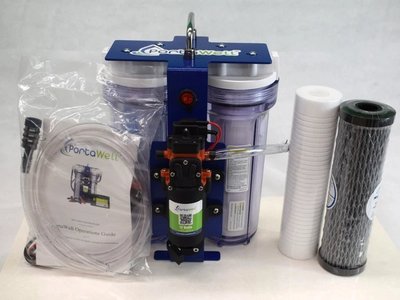
A common objection to the PortaWell system is that it needs electricity, and in a grid-down emergency electricity is exactly what you will not have. The concern is fair, but the power requirement is small enough to be solved with ordinary off-grid equipment, and the production increase is significant. The pump draws roughly 2.5–2.7 amps at 12 volts (about 30–32 watts)—low enough that a compact solar panel and battery can keep it running for hours each day. In return, the powered system delivers on the order of 40–60 gallons per hour, roughly 10–20 times the volume of a typical gravity filter, at modest cost and with readily available components. This article covers how to size and connect that setup, what daily water production is realistic under different conditions, and how to protect the electronics.
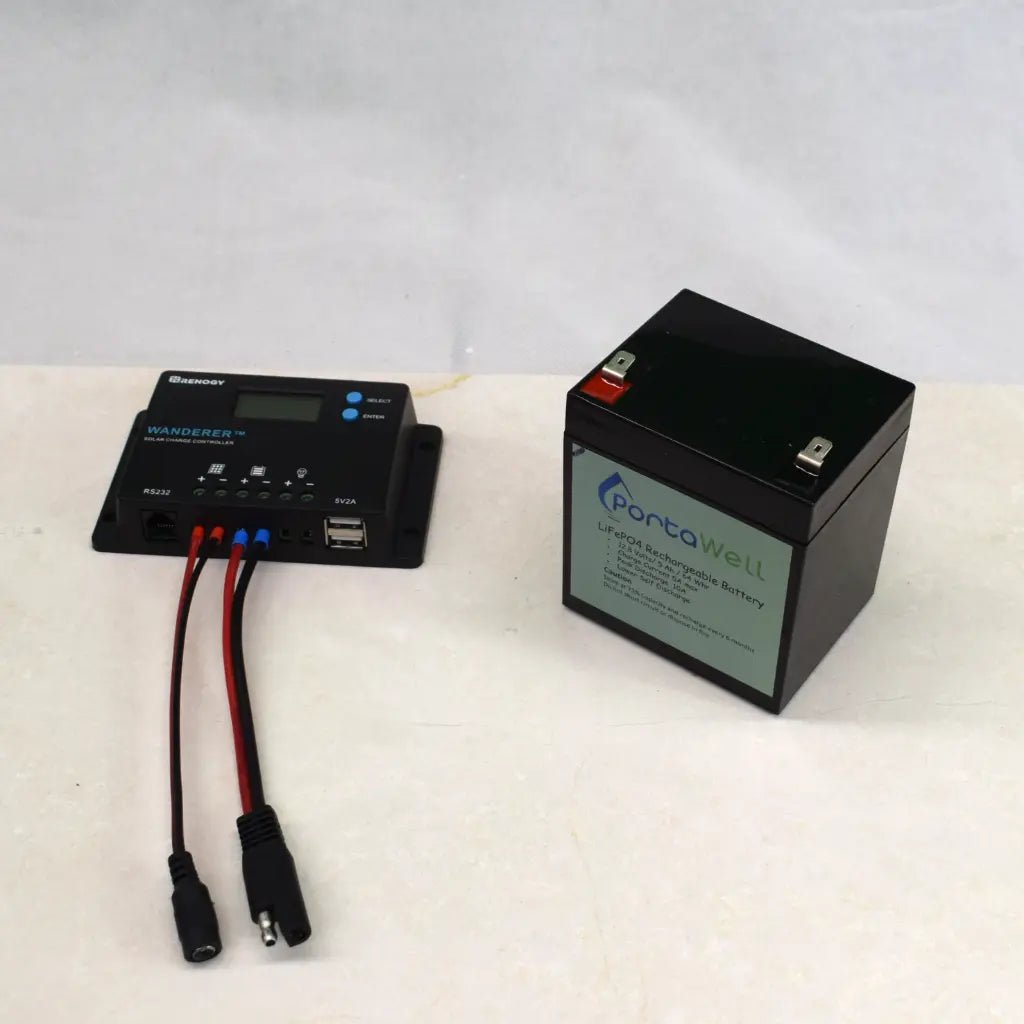
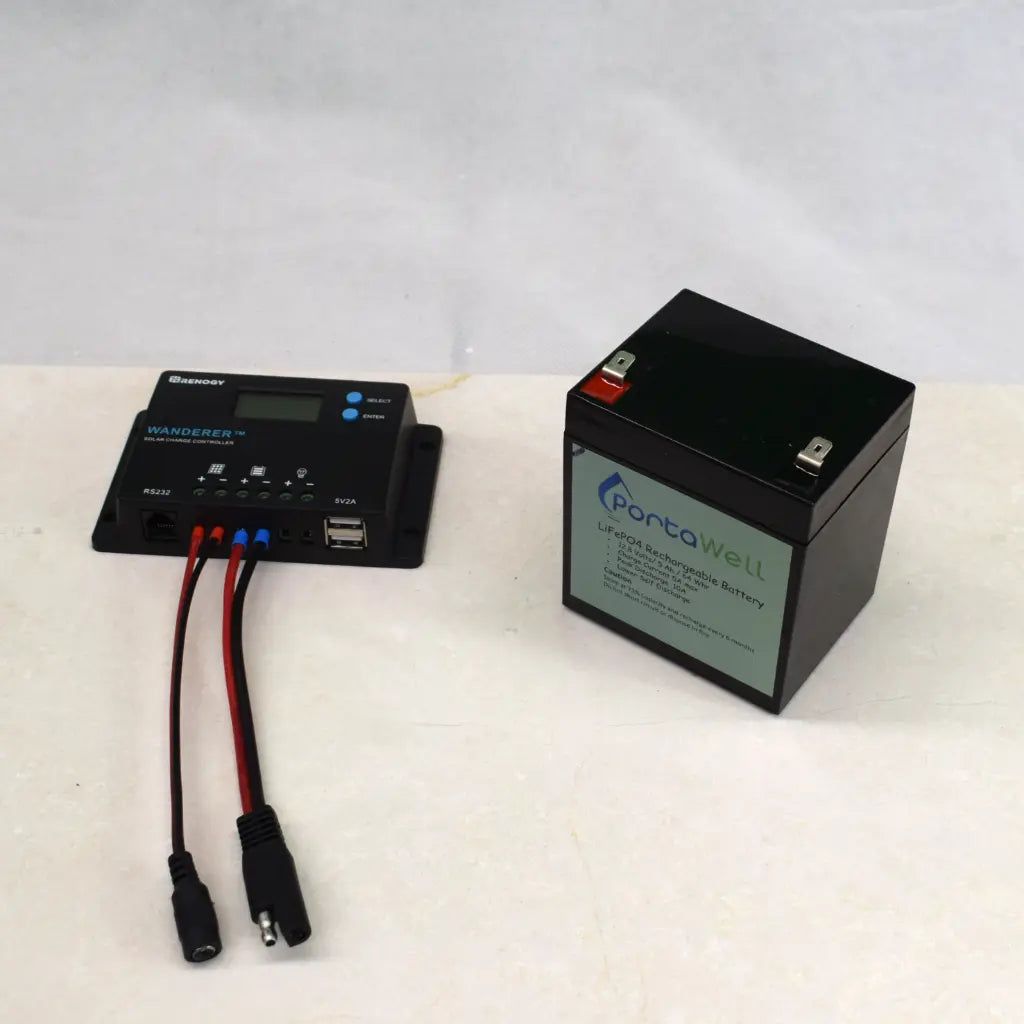
Solar Accessory Kit: the 12V LiFePO4 battery and charge controller. Solar panels are not included. Power accessories are sold separately.
What a Simple Solar Setup Can Produce
Start with the pump’s draw. At 2.5–2.7 A and 12 V it uses less power than many older household light bulbs. A 5 amp-hour LiFePO4 battery, kept with a 20 percent reserve, will run the pump for roughly 1.5 hours. At 0.75–1 gallon per minute that is on the order of 70–90 gallons before the battery needs recharging, provided the filters are clean.
A solar panel changes the picture. In full sun a 60-watt panel through a charge controller can deliver about 3 amps, roughly matching or slightly exceeding the pump’s draw. Run the PortaWell while the panel is charging and the battery acts mainly as a buffer: the panel supplies most of the power and the battery covers brief cloud cover. Do not run the pump directly from the panel; the battery smooths the sun’s variable output into steady voltage.
Daily yield depends on location, season, panel angle, and weather. In much of the western United States a typical summer day can provide about six hours of strong usable sunlight. After losses for heat, dust, and imperfect aiming, a 60-watt panel can put roughly 12–15 amp-hours into the system—enough for several hours of pumping and well over 200 gallons on a clear day when filters are healthy. In winter, shorter days and a lower sun often cut that to roughly half: on the order of 6–8 amp-hours, two to three hours of pumping, and 100–150+ gallons under good conditions in a sunny climate.
Powering Options
The PortaWell runs on 12 V DC and needs a source that can deliver a steady 3 A or more. Common choices:
- A regulated wall adapter (at least 5 A) that converts 120 volt AC to 12 volt DC is convenient for testing or pre-filling containers when grid power is available.
- A portable power station with a 12 V socket is the simplest complete package. Most include a built-in charge controller, so a compatible solar panel plugs in directly and the station manages charging. You still need the correct cables: one matching the station’s solar-input connector and a short, correctly polarized 12 V lead from the station’s socket to the PortaWell’s SAE plug. Once those two cables are verified, the setup has fewer separate pieces than a discrete panel + controller + battery arrangement.
- A generator can charge a battery or power station during short runs, but running one solely to power a 30 W pump is an inefficient use of fuel.
- A dedicated 12 V battery (LiFePO4 preferred) paired with a solar panel and charge controller forms a self-contained system. The PortaWell’s SAE battery-clamp cable connects directly.
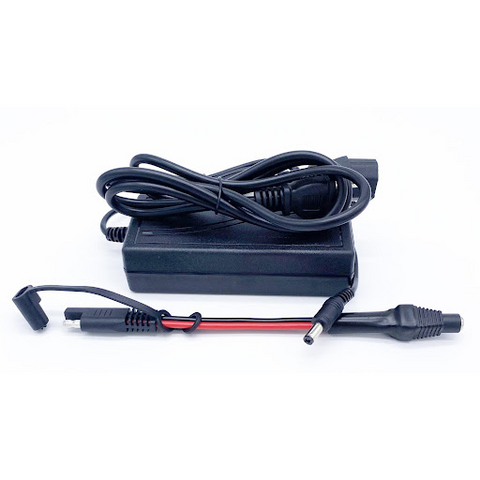
Run the pump from household or generator AC. Does not charge the LiFePO4 battery. SKU P12.
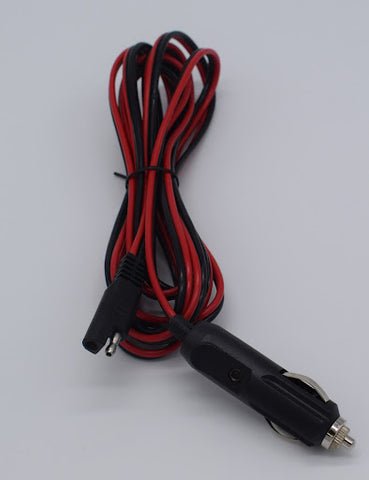
10 ft, 14 AWG: cigarette-style plug to SAE. For a vehicle or a power station with a 12V socket. SKU PWPT3.
Which cord to buy:
- Household outlet or generator: wall adapter (P12). It runs the pump. It does not charge the LiFePO4 pack.
- Already own a power station, or using a vehicle: car adapter (PWPT3) into the 12 V socket.
- Charging the PortaWell battery at home: the LiFePO4 charger (LICRG).
- Off-grid: battery plus controller (or the solar kit) plus a separate 50–60 W panel. The kit does not include the panel.
Choosing a Battery
A lithium iron phosphate (LiFePO4 / LFP) battery is the best match. It is lighter, lasts for thousands of cycles when treated properly, holds voltage well through most of its discharge, and has a low self-discharge rate (typically 1–3 % per month), so it needs less frequent attention in storage than lead-acid. A 5 Ah unit is the practical minimum; a 10 Ah unit doubles stored runtime and reduces depth of discharge. Lead-acid batteries work but need roughly double the rated capacity for similar usable energy and suffer more from repeated deep cycles. A car battery can serve in a pinch but is not designed for daily deep discharge.
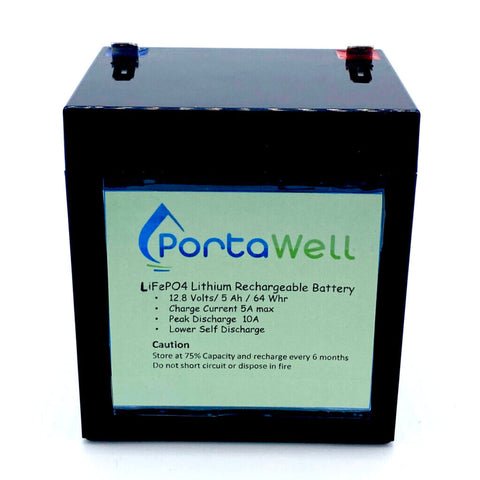
Lightweight lithium iron phosphate pack sized for PortaWell. Typical starting point for portable and emergency kits (~5AH class). SKU LIBAT.
Basic care: keep charge and discharge rates moderate (around half the amp-hour rating is comfortable), avoid running the battery flat (recharge LiFePO4 around 20 percent remaining), and observe the manufacturer’s maximum charge current. Most LiFePO4 batteries cannot be charged below freezing (32 °F / 0 °C); they will still power the pump in the cold, but charging while frozen can damage them. Some models include low-temperature protection or heaters. For storage, keep lithium batteries around half charge and check them periodically; store lead-acid fully charged. Always install an inline fuse on the positive lead close to the battery.
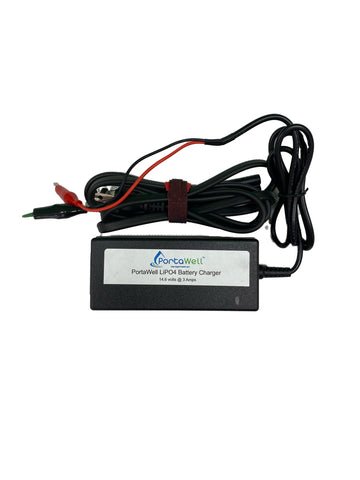
Dedicated home charger for the PortaWell 12V LiFePO4 battery from 120V AC. SKU LICRG. This charges the battery. The wall adapter does not.
Solar Charge Controllers
A charge controller sits between panel and battery. A “12 V” panel actually produces 18–21 V open-circuit; the controller converts that to a safe charging voltage and prevents overcharge. A 10 A controller is sufficient for a 60 W panel and a 5–10 Ah battery.
PWM controllers are inexpensive and adequate for this scale; they typically deliver about 70–80 percent of the panel’s rated power. MPPT controllers recover more energy (especially in cold weather) but cost more; for a small system the money is often better spent on a slightly larger panel. Choose a controller with an explicit LiFePO4 or lithium setting so it does not apply lead-acid equalization voltages.
Connect the battery to the controller first, then the panel. Disconnect in reverse order. If you use a portable power station, its built-in controller usually handles the solar input directly.
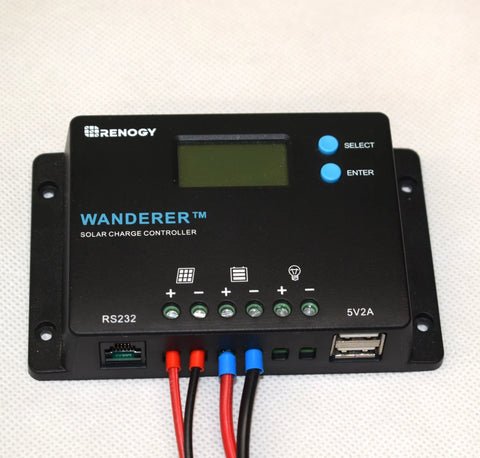
Sits between panel and battery. Needs a lithium / LiFePO4 setting. Prefer the controller’s load terminals for the pump when available. SKU SOLCTRL.
Solar Accessory Kit (KTSOL): the battery and controller shown above. Add a 12V panel of about 50–60 watts. Panels are not included.
Connecting Cables
Panel, controller, battery, and pump must mate correctly. Small portable panels commonly use barrel connectors (5.5 × 2.1 mm), SAE, MC4, or Anderson Powerpole. PortaWell’s battery cable uses SAE. Premade pigtails or simple adapters solve most mismatches; 16-gauge wire is adequate for short runs at these currents, 14-gauge for longer ones.
Polarity is not standardized across all SAE and barrel connectors. Verify with a multimeter before the first connection and mark the plugs. A reversed connection can destroy a controller instantly.
Protecting Electronics from EMP
An electromagnetic pulse (nuclear or severe solar) couples most strongly into long conductors. Small, self-contained equipment stored without long attached cables is at lower risk. The PortaWell pump is a simple motor with a mechanical pressure switch and has no sensitive electronics. A stored portable panel has only rugged bypass diodes. The components that contain electronics—the charge controller, the battery-management circuit inside a LiFePO4 battery, and any portable power station—are the ones worth protecting.
A metal container (galvanized trash can with a tight lid, interior lined so equipment does not touch the walls, seam sealed with aluminum foil tape) provides useful shielding. Keeping a spare controller in the container is inexpensive redundancy. No arrangement guarantees survival against every pulse strength and geometry, but the combination of low-risk motor/panel plus shielded or spare electronics leaves the system in a favorable position.
Conclusion
The PortaWell needs electricity, yet the amount is small enough that a modest solar-and-battery setup can supply it indefinitely. A 60-watt panel, a 5–10 Ah LiFePO4 battery, and a suitable charge controller can produce on the order of 100+ gallons per day under good winter conditions in a sunny climate, and substantially more in summer, provided filters are maintained. Results vary with weather, location, panel aiming, and how quickly the filters load.
Set the system up and test it on an ordinary sunny day: confirm connectors and polarity, verify the controller’s battery setting, and note how long the battery actually runs the pump with your filters. The time to discover a mismatch or a weak battery is in the backyard, not during an emergency. As long as surface water and sunlight are available, the power side of the problem is solvable.
Short video: Use Solar with PortaWell® (official PortaWell channel, 35 seconds). It shows a folding solar panel and a 12V battery being connected, then the PortaWell running.