PortaWell vs Berkey-Style Gravity Filters: Which Do You Need?
PortaWell Admin
Author
Quick answer: A Berkey-style gravity filter is a no-power countertop system practical for municipal tap water. PortaWell is a low-power (~35 W), ~1 GPM (gallons per minute) portable system built to process alternative surface sources when treated tap water is unavailable. Low hydrostatic head and the low dirt-holding capacity of ceramic media make sustained production from turbid surface water or stored water that has developed algae impractical on a gravity system; a pumped, staged arrangement removes that constraint.
Note: “Berkey-style” here means the familiar stainless gravity/countertop category (and similar brands). Claims, certifications, and element availability change—verify current specs. This page compares operating categories, not every SKU.
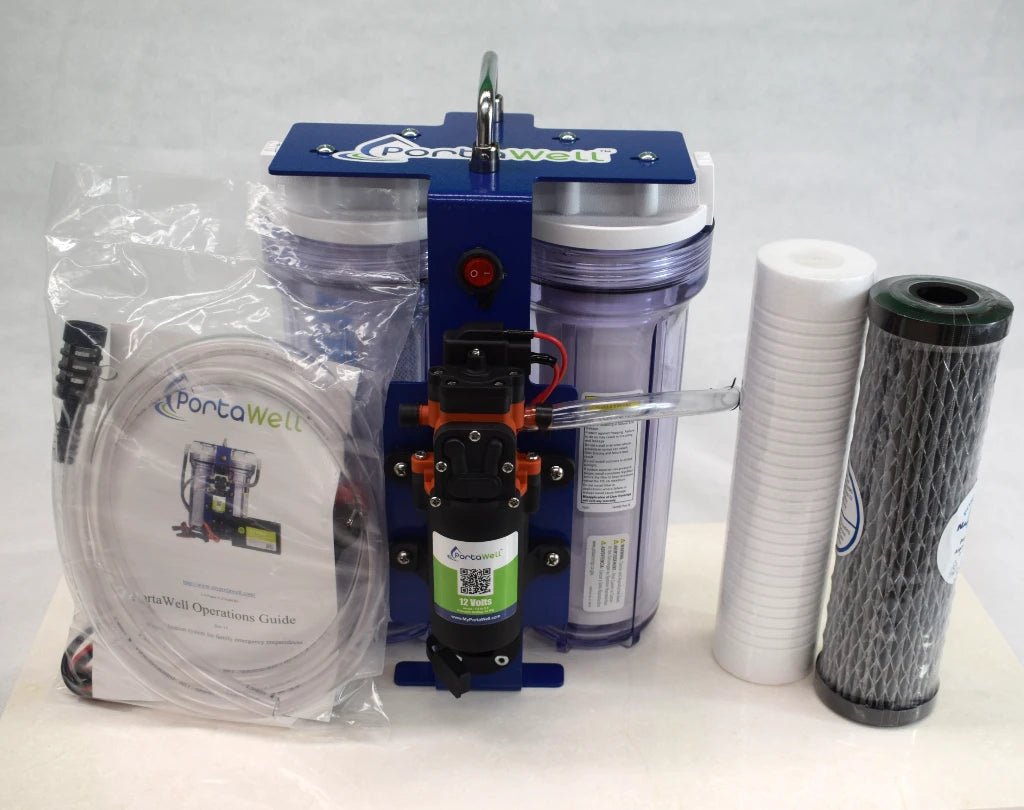
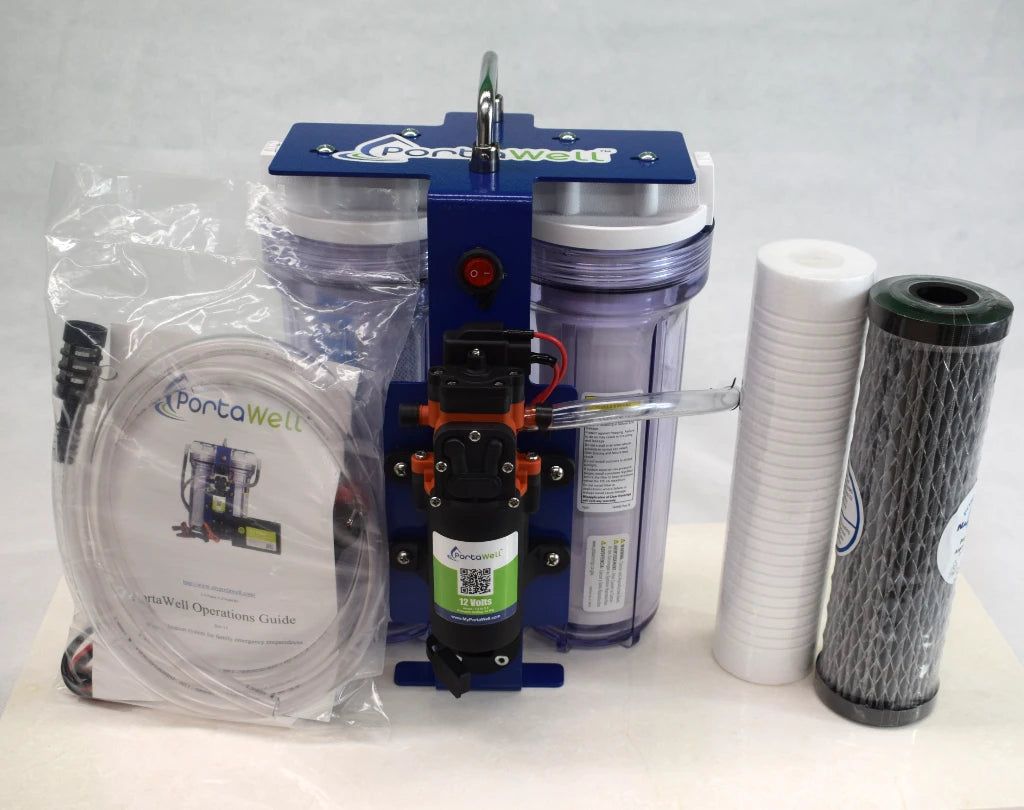
PortaWell is a powered, portable pump system—not a gravity crock. Different tool, different job.
Gravity countertop systems and portable field filters are the two categories most people encounter first. PortaWell occupies a third lane: a 12-volt powered, high-volume system designed for the case when treated municipal water is no longer available and surface sources must be used.
Gravity systems are driven only by the hydrostatic head of the water column in the upper chamber (typically well under 1–2 ft). Flow is already low and falls further as the chamber empties and as fine media load. Traditional ceramic elements are surface filters with low dirt-holding capacity; a thin cake layer raises pressure drop sharply. Algae color or fine organic matter—even in stored water—cakes the surface quickly and collapses flow until the element is cleaned. Settling does not reliably prevent this. A small pump maintains roughly constant pressure across staged cartridges (sediment stage protecting the finer stage), which is why ~40–60 gph rates from dirtier sources are practical.
PortaWell (powered): . PortaWell Mini (travel):
PortaWell (powered): Shop systems. PortaWell Mini (travel): Shop Mini
Side-by-side comparison
How it works. PortaWell: 12V pump. Berkey-style gravity: Gravity drip
Typical flow. PortaWell: Up to ~1 GPM (≈60 gallons per hour). Berkey-style gravity: Typically 1–4+ gallons per hour
Power needed. PortaWell: Battery / vehicle / solar. Berkey-style gravity: None
Best setting. PortaWell: Field processing of surface sources when tap is unavailable. Berkey-style gravity: Kitchen countertop on municipal tap water
Portability. PortaWell: High (bucket / compact). Berkey-style gravity: Low–medium (heavy)
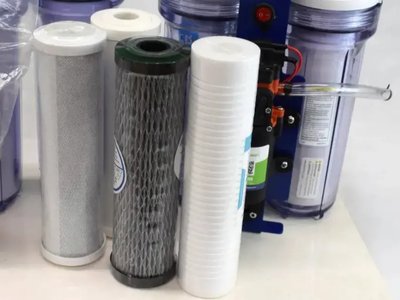
Filters. PortaWell: Standard OBE cartridges. Berkey-style gravity: Often brand-specific
Fill jugs / tanks. PortaWell: Excellent. Berkey-style gravity: Slow
Surface water. PortaWell: Designed for it with sediment staging. Berkey-style gravity: Impractical for sustained volume from turbid sources; low head + ceramic loading cause rapid flow collapse
Price class. PortaWell: From ~$249–$389. Berkey-style gravity: Often ~$200–$400+
*Gravity flow varies by model, elements, and clogging. PortaWell flow assumes healthy filters—see flow tips.
When a Berkey-style gravity filter wins
- No power required or available — fill the upper chamber and walk away
- Daily kitchen use on municipal tap water
- Silent operation during the long drip cycle that produces modest volumes
Gravity systems are simple and have no moving parts. Those advantages apply to municipal tap water. They do not overcome low hydrostatic head or the low dirt-holding capacity of ceramic media once the source is turbid surface water or stored water that has developed algae.
When PortaWell wins
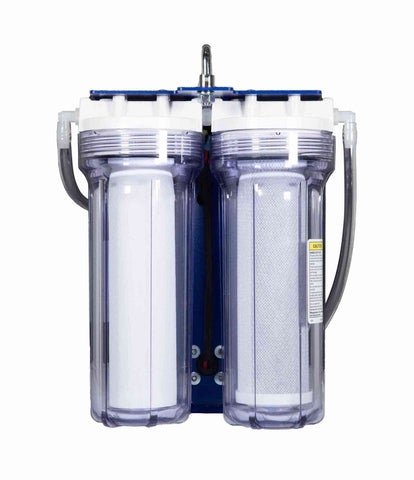
- Treated tap water is unavailable and you must use streams, ponds, pools, collected rain, or other surface sources
- Volume needed exceeds what gravity head can deliver in useful time
- Field and vehicle use — overlanding, RV tank fills, camping (Mini Expedition)
- Surface water with sediment — multi-stage stacks with a sediment pre-filter
- Non-proprietary filters — standard 10" or 5" OBE cartridges (filter guide)
- Expandable chemistry — add carbon or AquaMetix (Triple or expansion kit)
- Made in USA — family-built, sold direct at myportawell.com
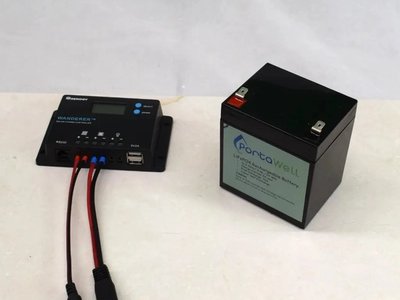
Power is supplied by any 12 V source (vehicle, battery, power station, or solar). Requirements are stated in the product instructions. For a shopping checklist of adapters and batteries, see How to power your PortaWell (publish when ready).
Looking for a gravity-system alternative?
Some shoppers arrive after gravity-element availability, certification, or regulatory headlines. A fair answer:
- If your goal is “same lifestyle as a stainless gravity crock” for municipal tap water, compare current gravity brands and elements first.
- If your goal is high-volume processing of surface sources when tap water is unavailable, PortaWell is a different category, not a drop-in clone.
Not sure which PortaWell? See Starter vs Mini vs Triple or the Product Finder.
Layered water plans
Gravity for quiet daily treatment of municipal tap water. PortaWell as the primary tool for producing volume from surface sources once tap water is gone. A personal straw or squeeze filter as a last-resort backup. Owning both is reasonable; depending on gravity alone for surface-water production is not.
Job: Daily municipal tap at home. Tool: Berkey-style gravity
Job: Surface sources when tap is unavailable. Tool: PortaWell
Job: Jug / tank fills in volume. Tool: PortaWell
Job: Go-bag personal backup. Tool: Straw / squeeze filter
Honest limits (both categories)
- Viruses: most portable microfilters and many gravity setups need a disinfection step for sewage-risk water
- Salt water: neither desalinate ocean water
- Fuel / toxic / radioactive special cases: don’t assume any consumer filter makes every hazard safe
- Claims: read the specific element/cartridge documentation
- Ceramic loading: traditional ceramic elements require cleaning when surface cake forms; staging a sediment pre-filter extends the interval but does not eliminate the need
Quick decision guide
- Buy a Berkey-style gravity filter if your main need is no-power countertop treatment of municipal tap water
- Buy PortaWell if you need to process surface sources at useful volume when tap water is unavailable
- Buy both only if you want kitchen convenience and field capability; do not treat the gravity unit as the emergency surface-water solution
Next steps
Conclusion
Two systems, two different applications. A Berkey-style gravity filter functions as a countertop appliance for treating municipal tap water. Its primary practical benefit is removal of chlorine and related taste/odor compounds, along with possible reduction of some trace contaminants in water that already meets EPA drinking-water guidelines. It is not suitable in the emergency water-treatment sphere other than, at the margin, a temporary boil-water advisory on otherwise clear municipal water. Low hydrostatic head and the low dirt-holding capacity of ceramic media make sustained production from turbid surface sources or algae-bearing stored water impractical.
PortaWell is the complementary architecture for the other application: low-power, high-volume processing of the surface sources that remain when treated tap water is gone.
FAQ
Is PortaWell better than a Berkey-style gravity filter?
Different jobs. Gravity is a no-power countertop system for municipal tap water. PortaWell is a powered ~1 GPM system for processing surface sources when tap water is unavailable.
Does PortaWell need electricity?
It needs 12V DC—battery, vehicle, power station, adapter, or solar. Gravity needs none. Power requirements are stated in the product instructions.
Which is faster?
PortaWell produces up to ~1 GPM (≈60 gallons per hour). Typical gravity systems produce 1–4+ gallons per hour. That is on the order of 10–20× the volume per hour under real conditions.
Are PortaWell filters proprietary?
No—standard OBE cartridges. Examples: NanoCeram PAC, sediment, carbon, AquaMetix.
Is PortaWell a drop-in replacement for a Berkey-style gravity filter?
No. It is a different architecture for a different primary job—high-volume surface-source processing rather than silent countertop treatment of municipal tap water.
If tap water stops and I have to use surface sources, can I depend on a Berkey-style gravity filter?
No, not as the primary system. Low available head and the low dirt-holding capacity of ceramic media make sustained production from typical turbid or algae-bearing water impractical. It remains usable only for municipal tap water.
Do these remove viruses?
Don’t assume yes. For sewage-risk water, filter then disinfect (boil/chlorinate) or use a virus-rated method. Check each product’s claims.
Questions? Contact us — support@myportawell.com · (435) 275-2521